Haematoxylin
Haematoxylin is a natural organic compound that is used in histology for staining. It is a basic dye that stains nuclei blue due to its affinity to nucleic acids in the cell nucleus. Haematoxylin is often used in combination with eosin, a process known as H&E staining, which is one of the most commonly used stains in histology.
History[edit]
Haematoxylin was first used as a histological stain in the mid-19th century. It was originally derived from the heartwood of the logwood tree (Haematoxylum campechianum), a species native to Central America and the West Indies.
Preparation and Use[edit]
Haematoxylin is typically used in its oxidized form, known as haematein. This is achieved by treating haematoxylin with a mordant, an agent that helps fix the stain in the tissue. The most commonly used mordant is aluminium, but others such as iron and tungsten can also be used, each giving a different colour to the stain.
Once the haematoxylin has been oxidized to haematein and combined with a mordant, it is ready to be used as a stain. The tissue to be stained is immersed in the haematoxylin solution, allowing the stain to penetrate the cells. The tissue is then washed and treated with a bluing agent to develop the colour.
Applications[edit]
Haematoxylin is primarily used in histology to stain cell nuclei. This makes it a crucial tool in the study of cell structure and function, and in the diagnosis of various diseases. It is also used in the field of cytology, the study of cells, as well as in histopathology, the study of disease in tissues.
See Also[edit]
References[edit]

This WikiMD article can only be edited by registered and verified editors. You can log in or register.
Haematoxylin[edit]
-
Haematoxylin powder
-
Hämatoxylin
-
Haematoxylin 3D ball
-
Haematoxylum campechianum wood chips
-
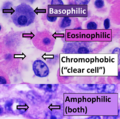 Eosinophilic, basophilic, chromophobic and amphophilic staining
 -
Hematoxylin solution

Advertise on WikiMD — 81,000+ full articles, ~900,000 total pages, ~250 million page views. Global reach, limited time promotional rates from $1/page/day. Learn more · View stats

Translate page: - East Asian
中文,
日本,
한국어,
South Asian
हिन्दी,
தமிழ்,
తెలుగు,
Urdu,
ಕನ್ನಡ,
Southeast Asian
Indonesian,
Vietnamese,
Thai,
မြန်မာဘာသာ,
বাংলা
European
español,
Deutsch,
français,
Greek,
português do Brasil,
polski,
română,
русский,
Nederlands,
norsk,
svenska,
suomi,
Italian
Middle Eastern & African
عربى,
Turkish,
Persian,
Hebrew,
Afrikaans,
isiZulu,
Kiswahili,
Other
Bulgarian,
Hungarian,
Czech,
Swedish,
മലയാളം,
मराठी,
ਪੰਜਾਬੀ,
ગુજરાતી,
Portuguese,
Ukrainian
About WikiMD • Contact • Disclaimer • Privacy • Copyright • Site statistics
Some content and images may originate from Wikimedia Commons or Wikipedia and remain subject to their stated licenses. Unless otherwise noted, eligible WikiMD content is available under CC BY-SA 4.0.
WikiMD Wellnesspedia — Free health & wellness information for patients, students, and health professionals.


