H3 receptor antagonist
H3 receptor antagonist is a class of drugs that selectively block the action of histamine at the H3 receptor, a subtype of histamine receptor. These drugs have potential therapeutic applications in the treatment of various central nervous system disorders.
History[edit]
The H3 receptor was first identified in the early 1980s, and the development of H3 receptor antagonists began in the late 1980s. The first H3 receptor antagonist to be discovered was Thioperamide, which was found to have potent and selective H3 receptor antagonist activity.
Mechanism of action[edit]
H3 receptor antagonists work by blocking the action of histamine at the H3 receptor. This receptor is found predominantly in the brain and is involved in a variety of functions, including the regulation of sleep and wakefulness, cognition, and appetite. By blocking the action of histamine at the H3 receptor, these drugs can enhance neurotransmitter release and improve cognitive function.
Therapeutic applications[edit]
H3 receptor antagonists have potential therapeutic applications in a variety of central nervous system disorders. These include narcolepsy, Alzheimer's disease, schizophrenia, and attention deficit hyperactivity disorder (ADHD). They may also have potential in the treatment of obesity due to their ability to suppress appetite.
Examples[edit]
Examples of H3 receptor antagonists include Thioperamide, Ciproxifan, and Pitolisant. Pitolisant is the first H3 receptor antagonist to be approved for the treatment of narcolepsy in the European Union and the United States.
Safety and side effects[edit]
Like all drugs, H3 receptor antagonists can have side effects. These can include insomnia, nausea, and headache. However, these side effects are generally mild and temporary.
Future research[edit]
Research into H3 receptor antagonists is ongoing, with many potential new drugs in the pipeline. This research is focused on improving the efficacy and safety of these drugs, as well as exploring their potential in the treatment of other disorders.

 | This neuroscience article is a stub. You can help WikiMD by expanding the page. |
H3 receptor antagonist gallery[edit]
-
 Thioperamide structure
 -
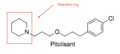 Pitolisant structure
 -
 H3 receptor antagonists SAR


Medical Disclaimer: WikiMD is for informational purposes only and is not a substitute for professional medical advice. Content may be inaccurate or outdated and should not be used for diagnosis or treatment. Always consult your healthcare provider for medical decisions. Verify information with trusted sources such as CDC.gov and NIH.gov. By using this site, you agree that WikiMD is not liable for any outcomes related to its content. See full disclaimer.
Credits:Most images are courtesy of Wikimedia commons, and templates, categories Wikipedia, licensed under CC BY SA or similar.
Translate page: - East Asian
中文,
日本,
한국어,
South Asian
हिन्दी,
தமிழ்,
తెలుగు,
Urdu,
ಕನ್ನಡ,
Southeast Asian
Indonesian,
Vietnamese,
Thai,
မြန်မာဘာသာ,
বাংলা
European
español,
Deutsch,
français,
Greek,
português do Brasil,
polski,
română,
русский,
Nederlands,
norsk,
svenska,
suomi,
Italian
Middle Eastern & African
عربى,
Turkish,
Persian,
Hebrew,
Afrikaans,
isiZulu,
Kiswahili,
Other
Bulgarian,
Hungarian,
Czech,
Swedish,
മലയാളം,
मराठी,
ਪੰਜਾਬੀ,
ગુજરાતી,
Portuguese,
Ukrainian

