Failure to thrive

Editor-In-Chief: Prab R Tumpati, MD
Obesity, Sleep & Internal medicine
Founder, WikiMD Wellnesspedia &
W8MD's weight loss doctor NYC
Philadelphia GLP-1 weight loss and GLP-1 clinic NYC
| Failure to thrive | |
|---|---|
 | |
| Synonyms | Growth failure, weight faltering |
| Pronounce | N/A |
| Specialty | N/A |
| Symptoms | Poor weight gain, malnutrition, developmental delay |
| Complications | Developmental delay, immune deficiency, short stature |
| Onset | Infancy or early childhood |
| Duration | Variable, depending on cause and treatment |
| Types | N/A |
| Causes | Inadequate caloric intake, malabsorption, chronic illness, neglect |
| Risks | Premature birth, low birth weight, chronic medical conditions |
| Diagnosis | Growth chart analysis, medical history, physical examination |
| Differential diagnosis | Celiac disease, cystic fibrosis, hypothyroidism, congenital heart disease |
| Prevention | N/A |
| Treatment | Nutritional support, addressing underlying causes, multidisciplinary approach |
| Medication | N/A |
| Prognosis | Varies; better with early intervention |
| Frequency | Common in pediatric practice |
| Deaths | N/A |
Failure to thrive (FTT) is a medical condition observed in infants and children who do not gain weight or grow as expected. It is not a disease or disorder itself, but rather a sign of underlying issues that may be nutritional, medical, or psychosocial in nature.
Definition[edit]
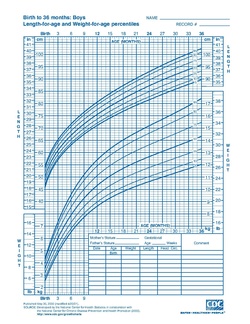
Failure to thrive is typically defined by a child's weight being below the 3rd or 5th percentile for their age and sex on standardized growth charts, or a significant drop in growth percentiles, such as crossing two major percentile lines. It is important to note that FTT is a descriptive term and not a diagnosis.
Causes[edit]
The causes of failure to thrive can be broadly categorized into three groups:
Organic Causes[edit]
Organic causes are related to medical conditions that affect a child's ability to take in, absorb, or utilize nutrients. These may include:
- Gastroesophageal reflux disease (GERD)
- Cystic fibrosis
- Congenital heart disease
- Chronic infections
- Metabolic disorders
Non-Organic Causes[edit]
Non-organic causes are often related to environmental or psychosocial factors, such as:
- Inadequate caloric intake due to improper feeding techniques
- Neglect or abuse
- Parental mental health issues
- Poverty or lack of access to food
Mixed Causes[edit]
In many cases, failure to thrive results from a combination of organic and non-organic factors. For example, a child with a mild medical condition may not receive adequate nutrition due to parental misunderstanding or lack of resources.
Diagnosis[edit]
Diagnosis of failure to thrive involves a comprehensive evaluation, including:
- Detailed medical history
- Physical examination
- Growth measurements plotted on standardized growth charts
- Laboratory tests to rule out underlying medical conditions
Management[edit]
Management of failure to thrive depends on the underlying cause. It may involve:
- Nutritional interventions, such as high-calorie diets or supplements
- Treatment of underlying medical conditions
- Psychosocial support for the family
- Education on proper feeding techniques
Prognosis[edit]
The prognosis for children with failure to thrive varies depending on the cause and the timeliness of intervention. Early identification and management can lead to significant improvements in growth and development.
See also[edit]
Sponsored Health Resource

W8MD Weight Loss, Sleep & MedSpa
Looking for physician-supervised weight loss, semaglutide, tirzepatide, or GLP-1 receptor agonist options? W8MD helps eligible patients in New York City, Brooklyn, New Jersey, Connecticut, Pennsylvania, Delaware, and greater Philadelphia with medical weight loss, sleep medicine, and long-term maintenance support.
GLP-1 specials: Affordable GLP-1 injections NYC and Philadelphia starting from $29.99/week and up for semaglutide with insurance accepted for qualifying visits, and $45/week and up for tirzepatide with insurance accepted for qualifying visits. Self-pay options start from $59.99/week and up for semaglutide and $69.99/week and up for tirzepatide.
Medical weight loss NYC | Affordable GLP-1 injections NYC | Budget GLP-1 weight loss shots Philadelphia | New Jersey medical weight loss | NYC medical weight loss | Philadelphia medical weight loss | Sleep clinic NYC | W8MD's Philadelphia GLP-1 doctor | Weight loss prescriptions NYC
Book a W8MD appointment · View GLP-1 specials
Paid promotional message. Eligibility, pricing, insurance coverage, medication availability, and results vary. Medical evaluation required.

Medical Disclaimer: WikiMD is for informational purposes only and is not a substitute for professional medical advice. Content may be inaccurate or outdated and should not be used for diagnosis or treatment. Always consult your healthcare provider for medical decisions. Verify information with trusted sources such as CDC.gov and NIH.gov. By using this site, you agree that WikiMD is not liable for any outcomes related to its content. See full disclaimer.
Credits:Most images are courtesy of Wikimedia commons, and templates, categories Wikipedia, licensed under CC BY SA or similar.
Translate page: - East Asian
中文,
日本,
한국어,
South Asian
हिन्दी,
தமிழ்,
తెలుగు,
Urdu,
ಕನ್ನಡ,
Southeast Asian
Indonesian,
Vietnamese,
Thai,
မြန်မာဘာသာ,
বাংলা
European
español,
Deutsch,
français,
Greek,
português do Brasil,
polski,
română,
русский,
Nederlands,
norsk,
svenska,
suomi,
Italian
Middle Eastern & African
عربى,
Turkish,
Persian,
Hebrew,
Afrikaans,
isiZulu,
Kiswahili,
Other
Bulgarian,
Hungarian,
Czech,
Swedish,
മലയാളം,
मराठी,
ਪੰਜਾਬੀ,
ગુજરાતી,
Portuguese,
Ukrainian

