Gantry (medical)
A gantry in the medical field refers to a structure used in various medical imaging devices, such as computed tomography (CT) scanners and magnetic resonance imaging (MRI) machines. The gantry houses the components necessary for capturing the images, including the x-ray tube, detectors, and other essential parts.
Structure and Function[edit]
The gantry is a large, circular structure that the patient is moved into for imaging. It rotates around the patient, capturing images from various angles. This rotation allows for the creation of cross-sectional images, which can be combined to form a three-dimensional image of the patient's body.
In a CT scanner, the x-ray tube and detectors are located opposite each other within the gantry. As the gantry rotates, the x-ray tube emits a beam of x-rays that passes through the patient's body and is detected by the detectors on the opposite side. The detectors measure the amount of x-rays that pass through the body, and this information is used to create an image.
In an MRI machine, the gantry houses the main magnet, gradient coils, and radiofrequency coils. The main magnet creates a strong magnetic field, the gradient coils create a varying magnetic field, and the radiofrequency coils emit and receive radio waves. These components work together to create images of the body's internal structures.
Types of Gantries[edit]
There are several types of gantries used in medical imaging, including fixed gantries and rotating gantries. Fixed gantries are stationary and the patient is moved through the gantry on a movable table. Rotating gantries, on the other hand, rotate around the patient while the patient remains stationary.
Applications[edit]
Gantries are used in a variety of medical imaging applications, including diagnostic imaging, radiation therapy, and interventional radiology. In diagnostic imaging, gantries are used to capture detailed images of the body's internal structures. In radiation therapy, gantries are used to deliver targeted doses of radiation to treat cancer. In interventional radiology, gantries are used to guide minimally invasive procedures.
See Also[edit]
- Computed tomography
- Magnetic resonance imaging
- Diagnostic imaging
- Radiation therapy
- Interventional radiology
 | This medical article is a stub. You can help WikiMD by expanding the page. |
-
 Linear accelerator used in radiotherapy
 -
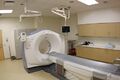 CT scanner at UPMC East
 -
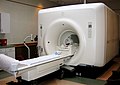 Large MRI machine
 -
 Radiotherapy equipment
 -
 Clinac linear accelerator


Medical Disclaimer: WikiMD is for informational purposes only and is not a substitute for professional medical advice. Content may be inaccurate or outdated and should not be used for diagnosis or treatment. Always consult your healthcare provider for medical decisions. Verify information with trusted sources such as CDC.gov and NIH.gov. By using this site, you agree that WikiMD is not liable for any outcomes related to its content. See full disclaimer.
Credits:Most images are courtesy of Wikimedia commons, and templates, categories Wikipedia, licensed under CC BY SA or similar.
Translate page: - East Asian
中文,
日本,
한국어,
South Asian
हिन्दी,
தமிழ்,
తెలుగు,
Urdu,
ಕನ್ನಡ,
Southeast Asian
Indonesian,
Vietnamese,
Thai,
မြန်မာဘာသာ,
বাংলা
European
español,
Deutsch,
français,
Greek,
português do Brasil,
polski,
română,
русский,
Nederlands,
norsk,
svenska,
suomi,
Italian
Middle Eastern & African
عربى,
Turkish,
Persian,
Hebrew,
Afrikaans,
isiZulu,
Kiswahili,
Other
Bulgarian,
Hungarian,
Czech,
Swedish,
മലയാളം,
मराठी,
ਪੰਜਾਬੀ,
ગુજરાતી,
Portuguese,
Ukrainian

