Prostacyclin
Prostacyclin (also called PGI2) is a prostaglandin member of the eicosanoid family of lipid molecules. It is produced in the walls of blood vessels and serves as an important vasodilator and inhibitor of platelet aggregation.
Production[edit]
Prostacyclin is produced from prostaglandin H2 by the action of the enzyme prostacyclin synthase. It is produced primarily in the endothelium of arterial blood vessels. The production of prostacyclin is one of the main ways the body regulates blood flow and clotting.
Function[edit]
Prostacyclin serves several important functions in the body. It is a potent vasodilator, meaning it helps to widen blood vessels and increase blood flow. It also inhibits platelet aggregation, which is the clumping together of platelets in the blood. This helps to prevent the formation of blood clots. Prostacyclin also has anti-inflammatory effects and can help to protect the heart and blood vessels from damage.
Clinical significance[edit]
Prostacyclin and its analogues are used in the treatment of pulmonary arterial hypertension. They work by dilating the blood vessels in the lungs, which reduces the pressure in these vessels and improves symptoms. Prostacyclin is also being investigated for its potential use in the treatment of other conditions, such as atherosclerosis and cancer.
See also[edit]

This WikiMD article can only be edited by registered and verified editors. You can log in or register.
-
Prostacyclin chemical structure
-
Prostacyclin space-filling model
-
Prostacyclin
-
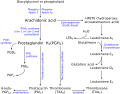 Eicosanoid synthesis pathway


Medical Disclaimer: WikiMD is for informational purposes only and is not a substitute for professional medical advice. Content may be inaccurate or outdated and should not be used for diagnosis or treatment. Always consult your healthcare provider for medical decisions. Verify information with trusted sources such as CDC.gov and NIH.gov. By using this site, you agree that WikiMD is not liable for any outcomes related to its content. See full disclaimer.
Credits:Most images are courtesy of Wikimedia commons, and templates, categories Wikipedia, licensed under CC BY SA or similar.
Translate page: - East Asian
中文,
日本,
한국어,
South Asian
हिन्दी,
தமிழ்,
తెలుగు,
Urdu,
ಕನ್ನಡ,
Southeast Asian
Indonesian,
Vietnamese,
Thai,
မြန်မာဘာသာ,
বাংলা
European
español,
Deutsch,
français,
Greek,
português do Brasil,
polski,
română,
русский,
Nederlands,
norsk,
svenska,
suomi,
Italian
Middle Eastern & African
عربى,
Turkish,
Persian,
Hebrew,
Afrikaans,
isiZulu,
Kiswahili,
Other
Bulgarian,
Hungarian,
Czech,
Swedish,
മലയാളം,
मराठी,
ਪੰਜਾਬੀ,
ગુજરાતી,
Portuguese,
Ukrainian


