Fetal surgery
Fetal surgery is a highly specialized surgical intervention to treat birth defects in fetuses who are still in the prenatal stage. This procedure can be categorized into two types: open fetal surgery and minimally invasive fetoscopic surgery.
Open Fetal Surgery[edit]
Open fetal surgery involves a comprehensive surgical procedure performed on the mother and the fetus. In this procedure, the mother's abdomen and uterus are opened, and the fetus is partially removed to allow the surgeon to operate on the fetus. After the surgery, the fetus is returned to the uterus, and the mother's uterus and abdomen are closed.
Minimally Invasive Fetoscopic Surgery[edit]
Minimally invasive fetoscopic surgery is a less invasive procedure that involves making small incisions in the mother's abdomen. A small camera, or fetoscope, is inserted through one of the incisions to provide a view of the fetus. The surgeon uses long, thin instruments to perform the surgery while watching a video monitor.
Conditions Treated[edit]
Fetal surgery is used to treat a variety of congenital anomalies. Some of the conditions that can be treated with fetal surgery include:
- Spina bifida
- Congenital diaphragmatic hernia
- Sacrococcygeal teratoma
- Twin-to-twin transfusion syndrome
- Amniotic band syndrome
- Congenital cystic adenomatoid malformation
- Urinary tract obstruction
Risks and Complications[edit]
Like any surgical procedure, fetal surgery carries potential risks and complications. These can affect both the mother and the fetus. Some of the potential risks and complications include:
- Premature birth
- Infection
- Need for cesarean delivery
- Potential for future pregnancies to be affected
See Also[edit]
References[edit]

This WikiMD article can only be edited by registered and verified editors. You can log in or register.
-
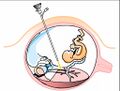 Fetal surgery

Advertise on WikiMD — 81,000+ full articles, ~900,000 total pages, ~250 million page views. Global reach, limited time promotional rates from $1/page/day. Learn more · View stats

Translate page: - East Asian
中文,
日本,
한국어,
South Asian
हिन्दी,
தமிழ்,
తెలుగు,
Urdu,
ಕನ್ನಡ,
Southeast Asian
Indonesian,
Vietnamese,
Thai,
မြန်မာဘာသာ,
বাংলা
European
español,
Deutsch,
français,
Greek,
português do Brasil,
polski,
română,
русский,
Nederlands,
norsk,
svenska,
suomi,
Italian
Middle Eastern & African
عربى,
Turkish,
Persian,
Hebrew,
Afrikaans,
isiZulu,
Kiswahili,
Other
Bulgarian,
Hungarian,
Czech,
Swedish,
മലയാളം,
मराठी,
ਪੰਜਾਬੀ,
ગુજરાતી,
Portuguese,
Ukrainian
About WikiMD • Contact • Disclaimer • Privacy • Copyright • Site statistics
Some content and images may originate from Wikimedia Commons or Wikipedia and remain subject to their stated licenses. Unless otherwise noted, eligible WikiMD content is available under CC BY-SA 4.0.
WikiMD Wellnesspedia — Free health & wellness information for patients, students, and health professionals.

