Electromagnetism
Electromagnetism is a branch of physics involving the study of the electromagnetic force, a type of physical interaction that occurs between electrically charged particles. The electromagnetic force is one of the four fundamental interactions in nature, the other three being the strong interaction, the weak interaction, and gravitation.
Overview[edit]
Electromagnetism is the force responsible for practically all the phenomena encountered in daily life, with the exception of gravity. Ordinary matter takes its form as a result of intermolecular forces between individual molecules in matter. Electromagnetism is also responsible for the chemical reactions which occur in chemical compounds.
History[edit]
The science of electromagnetism was developed over several centuries and was completed in its modern form by James Clerk Maxwell in the 19th century. Maxwell's equations describe how electric and magnetic fields interact to produce electromagnetic radiation, such as light.
Electromagnetic Force[edit]
The electromagnetic force is one of the four known fundamental forces. The other fundamental forces are the strong nuclear force, the weak nuclear force, and gravity. Of these four forces, the electromagnetic force is the one responsible for the interactions of charged particles.
Electromagnetic Fields[edit]
An electromagnetic field (also EMF or EM field) is a physical field produced by electrically charged objects. It affects the behavior of charged objects in the vicinity of the field.
Electromagnetic Radiation[edit]
Electromagnetic radiation refers to the waves of the electromagnetic field, propagating (radiating) through space, carrying electromagnetic radiant energy. It includes radio waves, microwaves, infrared, (visible) light, ultraviolet, X-rays, and gamma rays.
See Also[edit]
References[edit]

This WikiMD article can only be edited by registered and verified editors. You can log in or register.
-
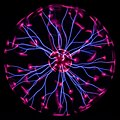 Plasma globe demonstrating electric fields
 -
 Illustration from A Treatise on Electricity and Magnetism
 -
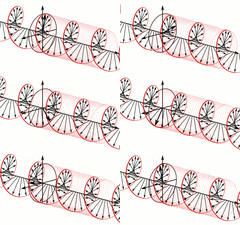 Animation of right-handed circularly polarized light


Medical Disclaimer: WikiMD is for informational purposes only and is not a substitute for professional medical advice. Content may be inaccurate or outdated and should not be used for diagnosis or treatment. Always consult your healthcare provider for medical decisions. Verify information with trusted sources such as CDC.gov and NIH.gov. By using this site, you agree that WikiMD is not liable for any outcomes related to its content. See full disclaimer.
Credits:Most images are courtesy of Wikimedia commons, and templates, categories Wikipedia, licensed under CC BY SA or similar.
Translate page: - East Asian
中文,
日本,
한국어,
South Asian
हिन्दी,
தமிழ்,
తెలుగు,
Urdu,
ಕನ್ನಡ,
Southeast Asian
Indonesian,
Vietnamese,
Thai,
မြန်မာဘာသာ,
বাংলা
European
español,
Deutsch,
français,
Greek,
português do Brasil,
polski,
română,
русский,
Nederlands,
norsk,
svenska,
suomi,
Italian
Middle Eastern & African
عربى,
Turkish,
Persian,
Hebrew,
Afrikaans,
isiZulu,
Kiswahili,
Other
Bulgarian,
Hungarian,
Czech,
Swedish,
മലയാളം,
मराठी,
ਪੰਜਾਬੀ,
ગુજરાતી,
Portuguese,
Ukrainian

