Drunk driving law by country
Drunk Driving Law by Country is a comprehensive overview of the legal regulations and penalties associated with driving under the influence (DUI) or driving while intoxicated (DWI) across different countries. These laws are designed to prevent accidents and fatalities caused by impaired driving due to alcohol consumption.
Overview[edit]
Drunk driving is a serious offense in many countries, with laws and penalties varying widely. The legal limit for blood alcohol concentration (BAC) also differs from country to country. In most cases, a BAC of 0.05% to 0.08% is considered the legal limit for driving.
By Country[edit]
United States[edit]
In the United States, drunk driving laws are enforced at the state level. All 50 states and the District of Columbia have laws in place making it illegal to drive with a BAC of 0.08% or higher.
United Kingdom[edit]
In the United Kingdom, the legal limit for drivers is 80 milligrams of alcohol per 100 millilitres of blood, 35 micrograms per 100 millilitres of breath, or 107 milligrams per 100 millilitres of urine.
Australia[edit]
In Australia, the legal BAC limit is 0.05%. Learner drivers and those who have held a license for less than three years are subject to a zero BAC limit.
Canada[edit]
In Canada, it is a criminal offense to operate a motor vehicle with a BAC of 0.08% or higher. Some provinces have additional sanctions for BAC levels as low as 0.05%.
Germany[edit]
In Germany, the legal BAC limit is 0.05%. However, for drivers under the age of 21 or those who have held a license for less than two years, a zero BAC limit applies.
See Also[edit]
References[edit]
<references />


Drunk_driving_law_by_country[edit]
-
 Don't Mix 'Em 1937 poster
 -
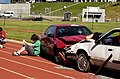 Nevada Union High School sign
 -
 Map of European countries by maximum blood alcohol level
 -
 Breathalyser 'pint' glass


Ad. Transform your life with W8MD's
GLP-1 weight loss injections special from $29.99 with insurance
|
WikiMD Medical Encyclopedia |
Medical Disclaimer: WikiMD is for informational purposes only and is not a substitute for professional medical advice. Content may be inaccurate or outdated and should not be used for diagnosis or treatment. Always consult your healthcare provider for medical decisions. Verify information with trusted sources such as CDC.gov and NIH.gov. By using this site, you agree that WikiMD is not liable for any outcomes related to its content. See full disclaimer.
Credits:Most images are courtesy of Wikimedia commons, and templates, categories Wikipedia, licensed under CC BY SA or similar.
Translate this page: - East Asian
中文,
日本,
한국어,
South Asian
हिन्दी,
தமிழ்,
తెలుగు,
Urdu,
ಕನ್ನಡ,
Southeast Asian
Indonesian,
Vietnamese,
Thai,
မြန်မာဘာသာ,
বাংলা
European
español,
Deutsch,
français,
Greek,
português do Brasil,
polski,
română,
русский,
Nederlands,
norsk,
svenska,
suomi,
Italian
Middle Eastern & African
عربى,
Turkish,
Persian,
Hebrew,
Afrikaans,
isiZulu,
Kiswahili,
Other
Bulgarian,
Hungarian,
Czech,
Swedish,
മലയാളം,
मराठी,
ਪੰਜਾਬੀ,
ગુજરાતી,
Portuguese,
Ukrainian
