Dodol
Dodol is a sweet toffee-like sugar confection, traditionally made with coconut milk, jaggery, and rice flour. It is a popular food item in various parts of South Asia and Southeast Asia.
History[edit]
The origins of dodol are unclear, but it is believed to have been introduced to Southeast Asia by Portuguese traders in the 16th century. It is a staple in many cultural celebrations in countries such as Indonesia, Malaysia, the Philippines, and Sri Lanka.
Preparation[edit]
The process of making dodol is time-consuming, often taking up to 9 hours. The ingredients are slowly cooked in a wood-fired stove until they form a sticky, thick paste. The mixture is then allowed to cool and harden before it is cut into pieces.
Variations[edit]
There are many variations of dodol, each with its unique ingredients and flavors. For example, in Indonesia, there is a version called Dodol Garut, which is made with milk and flavored with vanilla or durian. In Malaysia, a popular variant is Dodol Melaka, which is made with palm sugar.
Cultural Significance[edit]
Dodol is often served during festive occasions such as Eid al-Fitr, Christmas, and New Year's Day. It is also given as a gift during weddings and other special events.
Health Benefits[edit]
While dodol is high in calories due to its sugar content, it also provides some health benefits. Coconut milk is a good source of Vitamin C and potassium, while jaggery is rich in iron and magnesium.
See Also[edit]
- List of Indonesian desserts
- List of Malaysian desserts
- List of Filipino desserts
- List of Sri Lankan desserts

-
 Dodol side view
 -
 Peeling durians in the dodol factory
 -
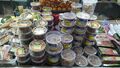 Dodols sold in a market in Sri Lanka
 -
 Pembuatan Dodol Betawi
 -
 Dodol susu
 -
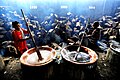 Pembuat Dodol
 -
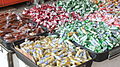 Dodol Garut Cihampelas Bandung
 -
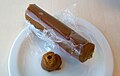 Durian cake


Medical Disclaimer: WikiMD is for informational purposes only and is not a substitute for professional medical advice. Content may be inaccurate or outdated and should not be used for diagnosis or treatment. Always consult your healthcare provider for medical decisions. Verify information with trusted sources such as CDC.gov and NIH.gov. By using this site, you agree that WikiMD is not liable for any outcomes related to its content. See full disclaimer.
Credits:Most images are courtesy of Wikimedia commons, and templates, categories Wikipedia, licensed under CC BY SA or similar.
Translate page: - East Asian
中文,
日本,
한국어,
South Asian
हिन्दी,
தமிழ்,
తెలుగు,
Urdu,
ಕನ್ನಡ,
Southeast Asian
Indonesian,
Vietnamese,
Thai,
မြန်မာဘာသာ,
বাংলা
European
español,
Deutsch,
français,
Greek,
português do Brasil,
polski,
română,
русский,
Nederlands,
norsk,
svenska,
suomi,
Italian
Middle Eastern & African
عربى,
Turkish,
Persian,
Hebrew,
Afrikaans,
isiZulu,
Kiswahili,
Other
Bulgarian,
Hungarian,
Czech,
Swedish,
മലയാളം,
मराठी,
ਪੰਜਾਬੀ,
ગુજરાતી,
Portuguese,
Ukrainian

