Desmoplastic small-round-cell tumor

Prab R. Tumpati, MD — Editor-in-Chief, WikiMD Medical Encyclopedia
Internal medicine • Obesity medicine • Sleep medicine
Professional affiliations: Founder of WikiMD and W8MD Weight Loss, Sleep & MedSpa.
Biography, credentials and affiliations • Editorial policy • Disclosure policy
| Desmoplastic small-round-cell tumor | |
|---|---|

| |
| Synonyms | DSRCT |
| Pronounce | N/A |
| Specialty | N/A |
| Symptoms | Abdominal pain, abdominal mass, gastrointestinal obstruction |
| Complications | Metastasis, organ dysfunction |
| Onset | Typically in adolescence or young adulthood |
| Duration | Chronic |
| Types | N/A |
| Causes | Unknown |
| Risks | Male gender, young age |
| Diagnosis | Biopsy, immunohistochemistry, cytogenetics |
| Differential diagnosis | Ewing sarcoma, rhabdomyosarcoma, neuroblastoma |
| Prevention | N/A |
| Treatment | Surgery, chemotherapy, radiation therapy |
| Medication | N/A |
| Prognosis | Poor |
| Frequency | Rare |
| Deaths | N/A |
Desmoplastic small-round-cell tumor (DSRCT) is a rare, highly aggressive and malignant tumor that primarily occurs as a mass in the abdomen.
Epidemiology[edit]
DSRCT predominantly affects adolescents and young adults, with a higher incidence in males. The exact prevalence of DSRCT is unknown due to its rarity, but it is estimated to account for less than 1% of all sarcomas.
Pathophysiology[edit]
DSRCT is characterized by the presence of small, round, blue cells in a desmoplastic stroma. The tumor is thought to originate from primitive mesenchymal cells, although the exact cell of origin is still a subject of debate. The hallmark of DSRCT is a specific chromosomal translocation, t(11;22)(p13;q12), which results in a fusion of the EWSR1 gene on chromosome 22 and the WT1 gene on chromosome 11.
Clinical Presentation[edit]
Patients with DSRCT typically present with abdominal pain, distension, or a palpable mass. Other symptoms may include anorexia, weight loss, and ascites. Due to the aggressive nature of the tumor, most patients have widespread metastasis at the time of diagnosis, most commonly to the liver, lungs, and bones.
Diagnosis[edit]
The diagnosis of DSRCT is based on histopathological examination of the tumor, which shows small, round, blue cells in a desmoplastic stroma. Immunohistochemistry is used to confirm the diagnosis, with the tumor cells typically showing positivity for desmin, vimentin, and neuron-specific enolase. The presence of the EWSR1-WT1 fusion gene can be detected by fluorescence in situ hybridization (FISH) or reverse transcription polymerase chain reaction (RT-PCR).
Treatment[edit]
The treatment of DSRCT is challenging due to its aggressive nature and resistance to therapy. Treatment options include surgery, chemotherapy, and radiotherapy. Despite aggressive treatment, the prognosis of DSRCT is poor, with a 5-year survival rate of less than 20%.
Research Directions[edit]
Current research is focused on understanding the molecular mechanisms underlying the development and progression of DSRCT, with the aim of developing targeted therapies. Clinical trials are ongoing to evaluate the efficacy of novel treatments such as immunotherapy and molecularly targeted therapy.
Gallery[edit]
-
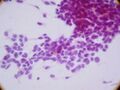 Desmoplastic small-round-cell tumor
 -
 Desmoplastic small-round-cell tumor


 | This medical article is a stub. You can help WikiMD by expanding the page. |
Advertise on WikiMD — 81,000+ full articles, ~900,000 total pages, ~250 million page views. Global reach, limited time promotional rates from $1/page/day. Learn more · View stats

Medical Disclaimer: WikiMD is for informational purposes only and is not a substitute for professional medical advice. Content may be inaccurate or outdated and should not be used for diagnosis or treatment. Always consult your healthcare provider for medical decisions. Verify information with trusted sources such as CDC.gov and NIH.gov. By using this site, you agree that WikiMD is not liable for any outcomes related to its content. See full disclaimer.
Credits:Most images are courtesy of Wikimedia commons, and templates, categories Wikipedia, licensed under CC BY SA or similar.
Translate page: - East Asian
中文,
日本,
한국어,
South Asian
हिन्दी,
தமிழ்,
తెలుగు,
Urdu,
ಕನ್ನಡ,
Southeast Asian
Indonesian,
Vietnamese,
Thai,
မြန်မာဘာသာ,
বাংলা
European
español,
Deutsch,
français,
Greek,
português do Brasil,
polski,
română,
русский,
Nederlands,
norsk,
svenska,
suomi,
Italian
Middle Eastern & African
عربى,
Turkish,
Persian,
Hebrew,
Afrikaans,
isiZulu,
Kiswahili,
Other
Bulgarian,
Hungarian,
Czech,
Swedish,
മലയാളം,
मराठी,
ਪੰਜਾਬੀ,
ગુજરાતી,
Portuguese,
Ukrainian

