Cytotrophoblast
Cytotrophoblast is a layer of cells in the placenta that is part of the trophoblast, which forms the outer layer of a blastocyst. It provides nutrients to the embryo and develops into a large part of the placenta. It forms the boundary of the chorionic villus and also gives rise to the syncytiotrophoblast, a multinucleated cell layer that covers the placenta.
Structure[edit]
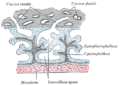
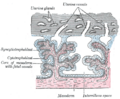
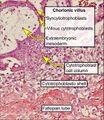
The cytotrophoblast is a layer of cuboidal epithelial cells that lines the chorionic villi. These cells are capable of mitosis, and they proliferate and differentiate to form the syncytiotrophoblast. The cytotrophoblast is also responsible for the production of chorionic gonadotropin (hCG), a hormone that maintains the corpus luteum during the early stages of pregnancy.
Function[edit]
The main function of the cytotrophoblast is to provide nutrients to the developing embryo. It does this by forming the chorionic villi, which are finger-like projections that extend into the endometrium of the uterus. The chorionic villi increase the surface area for the exchange of nutrients and waste products between the mother and the fetus.
The cytotrophoblast also plays a crucial role in the formation of the placenta. It proliferates and differentiates to form the syncytiotrophoblast, which is a multinucleated cell layer that covers the placenta. The syncytiotrophoblast is responsible for the production of hormones that maintain pregnancy and promote the growth and development of the fetus.
Clinical significance[edit]
Abnormalities in the cytotrophoblast can lead to various pregnancy complications, such as pre-eclampsia, intrauterine growth restriction, and placental abruption. In pre-eclampsia, the cytotrophoblast fails to invade the maternal spiral arteries properly, leading to inadequate blood flow to the placenta. In intrauterine growth restriction, the cytotrophoblast may not proliferate and differentiate properly, leading to a small placenta and a small fetus. In placental abruption, the cytotrophoblast may detach from the uterine wall, leading to bleeding and potentially life-threatening complications for the mother and the fetus.
See also[edit]

This WikiMD article can only be edited by registered and verified editors. You can log in or register.
Cytotrophoblast[edit]
-
 Cytotrophoblast
 -
 Cytotrophoblast
 -
 Cytotrophoblast
 -
 Cytotrophoblast


Medical Disclaimer: WikiMD is for informational purposes only and is not a substitute for professional medical advice. Content may be inaccurate or outdated and should not be used for diagnosis or treatment. Always consult your healthcare provider for medical decisions. Verify information with trusted sources such as CDC.gov and NIH.gov. By using this site, you agree that WikiMD is not liable for any outcomes related to its content. See full disclaimer.
Credits:Most images are courtesy of Wikimedia commons, and templates, categories Wikipedia, licensed under CC BY SA or similar.
Translate page: - East Asian
中文,
日本,
한국어,
South Asian
हिन्दी,
தமிழ்,
తెలుగు,
Urdu,
ಕನ್ನಡ,
Southeast Asian
Indonesian,
Vietnamese,
Thai,
မြန်မာဘာသာ,
বাংলা
European
español,
Deutsch,
français,
Greek,
português do Brasil,
polski,
română,
русский,
Nederlands,
norsk,
svenska,
suomi,
Italian
Middle Eastern & African
عربى,
Turkish,
Persian,
Hebrew,
Afrikaans,
isiZulu,
Kiswahili,
Other
Bulgarian,
Hungarian,
Czech,
Swedish,
മലയാളം,
मराठी,
ਪੰਜਾਬੀ,
ગુજરાતી,
Portuguese,
Ukrainian

