Chorionic villi
Chorionic villi are microscopic, finger-like projections that emerge from the embryo's chorion to provide maximum contact area with the maternal blood. They are a critical part of the placenta, facilitating the exchange of nutrients, gases, and wastes between the mother and the fetus.
Structure[edit]
The chorionic villi are composed of a core of mesoderm cells, which includes blood vessels, surrounded by two layers of trophoblast cells. The outer layer, known as the syncytiotrophoblast, is in direct contact with maternal blood, while the inner layer, the cytotrophoblast, provides support.
Function[edit]
The primary function of the chorionic villi is to facilitate the exchange of nutrients, gases, and wastes between the mother and the fetus. The villi are bathed in maternal blood, and the thin walls of the villi allow for the easy diffusion of substances between the maternal and fetal bloodstreams.
In addition to this, the chorionic villi also produce several hormones, including human chorionic gonadotropin (hCG), which is crucial for maintaining pregnancy.
Clinical significance[edit]
Abnormalities in the development or function of the chorionic villi can lead to complications in pregnancy. For example, in placenta previa, the placenta implants too low in the uterus, potentially blocking the cervix and leading to bleeding.
Chorionic villus sampling (CVS) is a prenatal test where a small sample of chorionic villi is removed from the placenta for genetic testing. This can provide information about the baby's genetic health early in pregnancy.
See also[edit]

Chorionic_villi[edit]
-
Chorionic villus
-
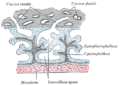 Gray's Anatomy illustration 36
 -
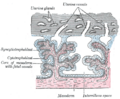 Gray's Anatomy illustration 37
 -
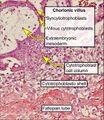 Histopathology of tubal pregnancy
 -
Gross pathology of fixed chorionic villi
-
Chorionic villi - intermediate magnification
-
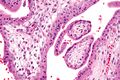 Chorionic villi - very high magnification
 -
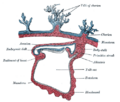 Gray's Anatomy illustration 21
 -
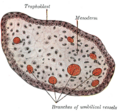 Gray's Anatomy illustration 35
 -
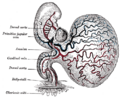 Gray's Anatomy illustration 459


Advertise on WikiMD — 81,000+ full articles, ~900,000 total pages, ~250 million page views. Global reach, limited time promotional rates from $1/page/day. Learn more · View stats


Translate page: - East Asian
中文,
日本,
한국어,
South Asian
हिन्दी,
தமிழ்,
తెలుగు,
Urdu,
ಕನ್ನಡ,
Southeast Asian
Indonesian,
Vietnamese,
Thai,
မြန်မာဘာသာ,
বাংলা
European
español,
Deutsch,
français,
Greek,
português do Brasil,
polski,
română,
русский,
Nederlands,
norsk,
svenska,
suomi,
Italian
Middle Eastern & African
عربى,
Turkish,
Persian,
Hebrew,
Afrikaans,
isiZulu,
Kiswahili,
Other
Bulgarian,
Hungarian,
Czech,
Swedish,
മലയാളം,
मराठी,
ਪੰਜਾਬੀ,
ગુજરાતી,
Portuguese,
Ukrainian
About WikiMD • Contact • Disclaimer • Privacy • Copyright • Site statistics
Some content and images may originate from Wikimedia Commons or Wikipedia and remain subject to their stated licenses. Unless otherwise noted, eligible WikiMD content is available under CC BY-SA 4.0.
WikiMD Wellnesspedia — Free health & wellness information for patients, students, and health professionals.


