Cooked rice
Cooked Rice is a staple food prepared by cooking the grains of the rice plant in water or steam, until they become tender. It is a fundamental component of many diets worldwide, particularly in Asia where it has been cultivated for thousands of years.
History[edit]
The cultivation of rice dates back to ancient times, with archaeological evidence suggesting it was grown in China as early as 5000 BC. It spread throughout Asia, reaching India, Korea, and Japan over the next few thousand years. The Moors introduced rice to Europe during their occupation of Spain in the 8th century, and it was later brought to the Americas by European colonists.
Preparation[edit]
Cooked rice is typically prepared by boiling or steaming rice grains. The grains are first rinsed to remove any dirt or excess starch. They are then added to boiling water or steam and cooked until they become tender. The exact cooking time can vary depending on the type of rice and the desired level of tenderness.
Varieties[edit]
There are many varieties of cooked rice, each with its own unique characteristics. These include white rice, brown rice, basmati rice, jasmine rice, and sticky rice. Each variety has a different flavor, texture, and nutritional profile.
Nutritional Value[edit]
Cooked rice is a good source of carbohydrates, providing energy for the body. It also contains small amounts of protein, fiber, and various vitamins and minerals. However, the nutritional value can vary significantly depending on the type of rice and the cooking method.
Cultural Significance[edit]
In many cultures, cooked rice is more than just a food. It has deep cultural and symbolic significance. For example, in China and other parts of Asia, rice is often associated with prosperity and fertility.
See Also[edit]

-
 Cooked rice
 -
 Cooked rice
 -
 Lao sticky rice
 -
 Qeema with rice
 -
 Steamed rice cake
 -
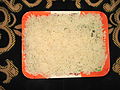 Boiled rice
 -
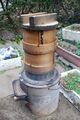 Steam glutinous rice with simple Japanese hearth
 -
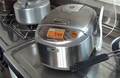 Rice cooker
 -
 Nasi hitam
 -
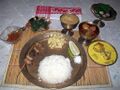 Assamese thali

_2.jpg)


Medical Disclaimer: WikiMD is for informational purposes only and is not a substitute for professional medical advice. Content may be inaccurate or outdated and should not be used for diagnosis or treatment. Always consult your healthcare provider for medical decisions. Verify information with trusted sources such as CDC.gov and NIH.gov. By using this site, you agree that WikiMD is not liable for any outcomes related to its content. See full disclaimer.
Credits:Most images are courtesy of Wikimedia commons, and templates, categories Wikipedia, licensed under CC BY SA or similar.
Translate page: - East Asian
中文,
日本,
한국어,
South Asian
हिन्दी,
தமிழ்,
తెలుగు,
Urdu,
ಕನ್ನಡ,
Southeast Asian
Indonesian,
Vietnamese,
Thai,
မြန်မာဘာသာ,
বাংলা
European
español,
Deutsch,
français,
Greek,
português do Brasil,
polski,
română,
русский,
Nederlands,
norsk,
svenska,
suomi,
Italian
Middle Eastern & African
عربى,
Turkish,
Persian,
Hebrew,
Afrikaans,
isiZulu,
Kiswahili,
Other
Bulgarian,
Hungarian,
Czech,
Swedish,
മലയാളം,
मराठी,
ਪੰਜਾਬੀ,
ગુજરાતી,
Portuguese,
Ukrainian

