Convoluted tubule
[[File: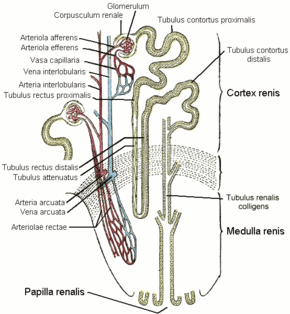 |frameless|alt=]]

| Details | |
|---|---|
| Synonyms | |
| Pronunciation | |
| Carnegie stage | |
| Days | |
| Precursor | Metanephric blastema |
| Gives rise to | |
| Part of | |
The convoluted tubule is a crucial component of the nephron, which is the functional unit of the kidney. It plays a vital role in the process of urine formation and the regulation of electrolyte balance in the body. The convoluted tubule is a highly specialized structure that consists of two distinct segments: the proximal convoluted tubule (PCT) and the distal convoluted tubule (DCT).
Proximal Convoluted Tubule[edit]
The proximal convoluted tubule is the first segment of the convoluted tubule and is located in the renal cortex. It is responsible for the reabsorption of various substances from the glomerular filtrate back into the bloodstream. This reabsorption process ensures the retention of essential substances such as glucose, amino acids, water, and electrolytes.
The PCT is lined with specialized cells called cuboidal epithelial cells. These cells possess numerous microvilli on their apical surface, which greatly increases the surface area available for reabsorption. The microvilli contain various transport proteins that facilitate the movement of substances across the cell membrane.
Distal Convoluted Tubule[edit]
The distal convoluted tubule is the second segment of the convoluted tubule and is located in the renal cortex and renal medulla. It is responsible for fine-tuning the composition of the urine by further reabsorbing or secreting specific substances. The DCT plays a crucial role in the regulation of electrolyte balance, particularly the reabsorption of sodium and calcium ions.
Similar to the PCT, the DCT is lined with cuboidal epithelial cells. However, these cells have fewer microvilli compared to the PCT. The DCT also contains specialized cells called macula densa cells, which are involved in the regulation of glomerular filtration rate.
Function[edit]
The convoluted tubules, both proximal and distal, are responsible for the reabsorption and secretion of various substances to maintain the body's homeostasis. They work in conjunction with other components of the nephron, such as the glomerulus and the loop of Henle, to regulate the composition and volume of urine.
The reabsorption of substances in the convoluted tubules is a highly selective process. It is regulated by various hormones, including antidiuretic hormone (ADH), aldosterone, and parathyroid hormone (PTH). These hormones modulate the permeability of the tubular epithelium and regulate the movement of water and electrolytes.
Clinical Significance[edit]
Disorders affecting the convoluted tubules can have significant implications for kidney function and overall health. Conditions such as renal tubular acidosis and Fanconi syndrome can impair the reabsorption and secretion processes in the tubules, leading to electrolyte imbalances and metabolic abnormalities.
Additionally, certain medications, such as diuretics, can directly affect the function of the convoluted tubules. Diuretics increase urine production by inhibiting the reabsorption of sodium and water in the tubules, which can be beneficial in conditions such as hypertension and edema.
References[edit]
_(14766693461).jpg)

Medical Disclaimer: WikiMD is for informational purposes only and is not a substitute for professional medical advice. Content may be inaccurate or outdated and should not be used for diagnosis or treatment. Always consult your healthcare provider for medical decisions. Verify information with trusted sources such as CDC.gov and NIH.gov. By using this site, you agree that WikiMD is not liable for any outcomes related to its content. See full disclaimer.
Credits:Most images are courtesy of Wikimedia commons, and templates, categories Wikipedia, licensed under CC BY SA or similar.
Translate page: - East Asian
中文,
日本,
한국어,
South Asian
हिन्दी,
தமிழ்,
తెలుగు,
Urdu,
ಕನ್ನಡ,
Southeast Asian
Indonesian,
Vietnamese,
Thai,
မြန်မာဘာသာ,
বাংলা
European
español,
Deutsch,
français,
Greek,
português do Brasil,
polski,
română,
русский,
Nederlands,
norsk,
svenska,
suomi,
Italian
Middle Eastern & African
عربى,
Turkish,
Persian,
Hebrew,
Afrikaans,
isiZulu,
Kiswahili,
Other
Bulgarian,
Hungarian,
Czech,
Swedish,
മലയാളം,
मराठी,
ਪੰਜਾਬੀ,
ગુજરાતી,
Portuguese,
Ukrainian

