Coffee preparation
Coffee preparation is the process of turning coffee beans into a beverage. While the particular steps vary with the type of coffee and with the raw materials, the process includes four basic steps: raw coffee beans must be roasted, the roasted coffee beans must then be ground, the ground coffee must then be mixed with hot water for a certain time (brewing), and finally the liquid coffee must be separated from the used grounds.
Roasting[edit]
Coffee roasting is heating coffee beans in a roasting machine. A good share of the coffee available in supermarkets is already ground. Coffee beans can be bought roasted by the supplier, or they can be roasted at home.
Grinding[edit]
Coffee grinding is the process of turning roasted beans into granules. While the particular steps vary with the type of coffee the process includes four basic steps: raw coffee beans must be roasted, the roasted coffee beans must then be ground, the ground coffee must then be mixed with hot water for a certain time (brewing), and finally the liquid coffee must be separated from the used grounds.
Brewing[edit]
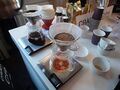
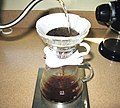
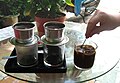
Coffee brewing involves mixing ground coffee with hot water and the extraction of the soluble contents of coffee into the water. Soluble contents of coffee include caffeine, oils and aromatic compounds. The remaining coffee grounds are then separated from the liquid.
Serving[edit]
Once the coffee is brewed, it is served hot. Some people add milk or cream to their coffee, or sweeten it with sugar or artificial sweeteners. Others prefer to drink it black.
Health effects[edit]
Health effects of coffee have been studied and indicate that moderate coffee consumption is benign or mildly beneficial in healthy adults. However, coffee can worsen certain conditions such as insomnia, heart disease, and anxiety.
See also[edit]

This WikiMD article can only be edited by registered and verified editors. You can log in or register.
-
 Coffee preparation
 -
 Coffee preparation
 -
 Coffee preparation
 -
 Coffee preparation
 -
 Coffee preparation
 -
 Coffee preparation
 -
 Coffee preparation
 -
 Coffee preparation
 -
 Coffee preparation
 -
 Coffee preparation
 -
 Coffee preparation
 -
 Coffee preparation


.JPG)


Advertise on WikiMD — 81,000+ full articles, ~900,000 total pages, ~250 million page views. Global reach, limited time promotional rates from $1/page/day. Learn more · View stats

Medical Disclaimer: WikiMD is for informational purposes only and is not a substitute for professional medical advice. Content may be inaccurate or outdated and should not be used for diagnosis or treatment. Always consult your healthcare provider for medical decisions. Verify information with trusted sources such as CDC.gov and NIH.gov. By using this site, you agree that WikiMD is not liable for any outcomes related to its content. See full disclaimer.
Credits:Most images are courtesy of Wikimedia commons, and templates, categories Wikipedia, licensed under CC BY SA or similar.
Translate page: - East Asian
中文,
日本,
한국어,
South Asian
हिन्दी,
தமிழ்,
తెలుగు,
Urdu,
ಕನ್ನಡ,
Southeast Asian
Indonesian,
Vietnamese,
Thai,
မြန်မာဘာသာ,
বাংলা
European
español,
Deutsch,
français,
Greek,
português do Brasil,
polski,
română,
русский,
Nederlands,
norsk,
svenska,
suomi,
Italian
Middle Eastern & African
عربى,
Turkish,
Persian,
Hebrew,
Afrikaans,
isiZulu,
Kiswahili,
Other
Bulgarian,
Hungarian,
Czech,
Swedish,
മലയാളം,
मराठी,
ਪੰਜਾਬੀ,
ગુજરાતી,
Portuguese,
Ukrainian

