Cerebral peduncle
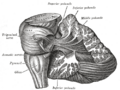
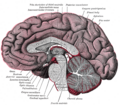
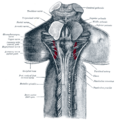
The cerebral peduncle is a significant part of the human brain, specifically within the midbrain. It is responsible for carrying messages from the cerebral cortex to the pons and spinal cord, playing a crucial role in motor control and sensory analysis.
Structure[edit]
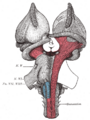
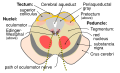
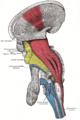
The cerebral peduncle is divided into three main parts: the crus cerebri, the substantia nigra, and the tegmentum. Each of these components has a unique function and structure that contributes to the overall operation of the cerebral peduncle.
Crus Cerebri[edit]
The crus cerebri, also known as the cerebral crus, is the anterior part of the cerebral peduncle. It contains the large pyramidal tract, which is responsible for carrying motor signals from the cerebral cortex to the spinal cord.
Substantia Nigra[edit]
The substantia nigra is a layer of grey matter located in the midbrain. It plays a significant role in reward, addiction, and movement. Dysfunction in this area is associated with Parkinson's disease.
Tegmentum[edit]
The tegmentum is the posterior part of the cerebral peduncle. It contains several cranial nerve nuclei and pathways, contributing to many functions including motor control, sensory analysis, and the regulation of consciousness.
Function[edit]
The cerebral peduncle plays a crucial role in motor control by transmitting motor signals from the cerebral cortex to the spinal cord. It also contributes to sensory analysis by carrying sensory information from the spinal cord to the thalamus.
Clinical Significance[edit]
Damage to the cerebral peduncle can result in a variety of neurological disorders, including Weber's syndrome and Parkinson's disease. Understanding the structure and function of the cerebral peduncle is therefore crucial in the diagnosis and treatment of these conditions.
See Also[edit]
 | This neuroscience article is a stub. You can help WikiMD by expanding the page. |

-
 Cerebral peduncle
 -
 Cerebral peduncle
 -
 Cerebral peduncle
 -
 Cerebral peduncle
 -
 Cerebral peduncle
 -
 Cerebral peduncle
 -
 Cerebral peduncle
 -
 Cerebral peduncle
 -
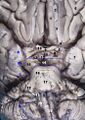 Cerebral peduncle


Medical Disclaimer: WikiMD is for informational purposes only and is not a substitute for professional medical advice. Content may be inaccurate or outdated and should not be used for diagnosis or treatment. Always consult your healthcare provider for medical decisions. Verify information with trusted sources such as CDC.gov and NIH.gov. By using this site, you agree that WikiMD is not liable for any outcomes related to its content. See full disclaimer.
Credits:Most images are courtesy of Wikimedia commons, and templates, categories Wikipedia, licensed under CC BY SA or similar.
Translate page: - East Asian
中文,
日本,
한국어,
South Asian
हिन्दी,
தமிழ்,
తెలుగు,
Urdu,
ಕನ್ನಡ,
Southeast Asian
Indonesian,
Vietnamese,
Thai,
မြန်မာဘာသာ,
বাংলা
European
español,
Deutsch,
français,
Greek,
português do Brasil,
polski,
română,
русский,
Nederlands,
norsk,
svenska,
suomi,
Italian
Middle Eastern & African
عربى,
Turkish,
Persian,
Hebrew,
Afrikaans,
isiZulu,
Kiswahili,
Other
Bulgarian,
Hungarian,
Czech,
Swedish,
മലയാളം,
मराठी,
ਪੰਜਾਬੀ,
ગુજરાતી,
Portuguese,
Ukrainian

