Cephalic index in cats and dogs
The Cephalic Index is a quantitative measure of the head shape in animals, particularly in cats and dogs. It is calculated by dividing the width of the head by its length and multiplying the result by 100. This index is used by veterinarians, breeders, and researchers to classify the head shapes of different breeds of cats and dogs, which can have implications for health, behavior, and breed standards.
Definition and Calculation[edit]
The Cephalic Index (CI) is defined as the ratio of the maximum width (B) of the head to its maximum length (L), multiplied by 100:
\[CI = \left( \frac{B}{L} \right) \times 100\]
Where:
- B = Maximum width of the head
- L = Maximum length of the head
The length is measured from the occiput (the back part of the skull) to the stop (the point between the eyes), and the width is measured at the widest part of the skull.
Classification[edit]
Based on the Cephalic Index, dog and cat breeds can be classified into three main categories:
- Dolichocephalic: Breeds with a long, narrow head (CI < 75). Examples include the Greyhound and the Siamese cat.
- Mesocephalic: Breeds with a moderately proportioned head (CI between 75 and 80). Examples include the Labrador Retriever and the Persian cat.
- Brachycephalic: Breeds with a short, wide head (CI > 80). Examples include the Bulldog and the Pug for dogs, and the Exotic Shorthair for cats.
Health Implications[edit]
The Cephalic Index is not just an aesthetic characteristic; it has significant health implications for both cats and dogs. Brachycephalic breeds, in particular, are prone to a range of health issues due to their skull shape, including breathing difficulties, dental problems, and eye conditions. Understanding the CI can help veterinarians and owners anticipate and manage these health concerns.
Breed Standards and Controversy[edit]
The CI is also important in the context of breed standards, where specific head shapes are often required for show animals. However, this has led to controversy, especially around the breeding of brachycephalic animals, with critics arguing that prioritizing appearance over health is unethical.
Research and Studies[edit]
Research into the Cephalic Index in cats and dogs continues to provide insights into the relationship between head shape and health, behavior, and even genetic background. Studies have explored everything from the impact of CI on respiratory function to its correlation with certain behavioral traits.
Conclusion[edit]
The Cephalic Index is a valuable tool for understanding the physical and health characteristics of different breeds of cats and dogs. By classifying animals based on their head shape, researchers, veterinarians, and breeders can better address the specific needs and challenges associated with each category.

-
 Chihuahua 01 K
 -
 Laki Justbluein
 -
 CP Riley Snow
 -
 American Shorthair
 -
 Kufa charta - borzoja
 -
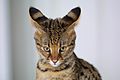 Savannah Cat closeup


Advertise on WikiMD — 81,000+ full articles, ~900,000 total pages, ~250 million page views. Global reach, limited time promotional rates from $1/page/day. Learn more · View stats


Translate page: - East Asian
中文,
日本,
한국어,
South Asian
हिन्दी,
தமிழ்,
తెలుగు,
Urdu,
ಕನ್ನಡ,
Southeast Asian
Indonesian,
Vietnamese,
Thai,
မြန်မာဘာသာ,
বাংলা
European
español,
Deutsch,
français,
Greek,
português do Brasil,
polski,
română,
русский,
Nederlands,
norsk,
svenska,
suomi,
Italian
Middle Eastern & African
عربى,
Turkish,
Persian,
Hebrew,
Afrikaans,
isiZulu,
Kiswahili,
Other
Bulgarian,
Hungarian,
Czech,
Swedish,
മലയാളം,
मराठी,
ਪੰਜਾਬੀ,
ગુજરાતી,
Portuguese,
Ukrainian
About WikiMD • Contact • Disclaimer • Privacy • Copyright • Site statistics
Some content and images may originate from Wikimedia Commons or Wikipedia and remain subject to their stated licenses. Unless otherwise noted, eligible WikiMD content is available under CC BY-SA 4.0.
WikiMD Wellnesspedia — Free health & wellness information for patients, students, and health professionals.

