Cholesterol side-chain cleavage enzyme
Cholesterol side-chain cleavage enzyme, also known as P450scc or CYP11A1, is a crucial enzyme in the biosynthesis of steroids. It catalyzes the conversion of cholesterol into pregnenolone, a process that marks the first step in the synthesis of all steroid hormones. This enzyme is found in the mitochondria of steroid-producing cells, particularly in the adrenal cortex, gonads, and the placenta. The activity of P450scc is essential for the production of glucocorticoids, mineralocorticoids, androgens, estrogens, and progestogens, which play vital roles in regulating metabolism, immune response, water balance, sexual development, and reproduction.
Function[edit]
The primary function of the cholesterol side-chain cleavage enzyme is to initiate the process of steroidogenesis by converting cholesterol into pregnenolone. This conversion involves the cleavage of a 6-carbon side chain from cholesterol. The enzyme utilizes electron transfer from NADPH via the adrenodoxin reductase and adrenodoxin system, which are also located in the mitochondria. This reaction is the rate-limiting step in the production of steroid hormones.
Structure[edit]
P450scc is a member of the cytochrome P450 superfamily of enzymes, which are characterized by their heme-binding domain. The enzyme's structure allows it to bind to cholesterol and facilitate its conversion into pregnenolone through a series of electron transfers and molecular rearrangements.
Clinical Significance[edit]
Mutations in the CYP11A1 gene, which encodes the P450scc enzyme, can lead to deficiencies in steroid hormone production. Such deficiencies may result in a variety of disorders, including Congenital Adrenal Hyperplasia (CAH), which is characterized by impaired production of cortisol and often an overproduction of androgenic steroids. Diagnosis of P450scc deficiency involves measuring the levels of steroid precursors and hormones in the blood and urine, along with genetic testing for mutations in the CYP11A1 gene.
Treatment[edit]
Treatment for conditions arising from P450scc deficiency typically involves hormone replacement therapy to correct the imbalance of steroid hormones. The specific treatment regimen depends on the hormones that are deficient.
Research Directions[edit]
Research on P450scc continues to explore its role in steroidogenesis and its implications for diseases related to steroid hormone imbalance. Studies are also investigating the potential for targeting this enzyme in the treatment of steroid hormone-dependent cancers.
 | This medical article is a stub. You can help WikiMD by expanding the page. |
-
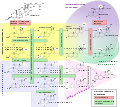 Diagram of steroidogenesis pathways
 -
 Structure of Dehydroepiandrosterone (DHEA)
 -
 Structure of Cholesterol
 -
 Structure of Pregnenolone


Medical Disclaimer: WikiMD is for informational purposes only and is not a substitute for professional medical advice. Content may be inaccurate or outdated and should not be used for diagnosis or treatment. Always consult your healthcare provider for medical decisions. Verify information with trusted sources such as CDC.gov and NIH.gov. By using this site, you agree that WikiMD is not liable for any outcomes related to its content. See full disclaimer.
Credits:Most images are courtesy of Wikimedia commons, and templates, categories Wikipedia, licensed under CC BY SA or similar.
Translate page: - East Asian
中文,
日本,
한국어,
South Asian
हिन्दी,
தமிழ்,
తెలుగు,
Urdu,
ಕನ್ನಡ,
Southeast Asian
Indonesian,
Vietnamese,
Thai,
မြန်မာဘာသာ,
বাংলা
European
español,
Deutsch,
français,
Greek,
português do Brasil,
polski,
română,
русский,
Nederlands,
norsk,
svenska,
suomi,
Italian
Middle Eastern & African
عربى,
Turkish,
Persian,
Hebrew,
Afrikaans,
isiZulu,
Kiswahili,
Other
Bulgarian,
Hungarian,
Czech,
Swedish,
മലയാളം,
मराठी,
ਪੰਜਾਬੀ,
ગુજરાતી,
Portuguese,
Ukrainian

