Bhel puri
Bhel Puri is a popular Indian street food originating from the Indian subcontinent. It is a type of chaat, a category of savory snacks typically served at roadside tracks from stalls or food carts in India, Bangladesh, and Pakistan. Bhel Puri is especially popular in the Indian states of Maharashtra, Gujarat, and West Bengal.
Ingredients[edit]
Bhel Puri is made from puffed rice and sev (a fried snack shaped like thin noodles made from gram flour), mixed with potatoes, onions, chat masala, and a variety of chutneys. The chutneys used are usually tamarind, mint, and coriander chutneys. Some variations may include raw mango or a hint of lemon juice.
Variations[edit]
There are two main types of Bhel Puri: dry and wet. The dry type is simply the mixture of the ingredients, while the wet type includes the addition of various chutneys. There are also regional variations. For example, in Mumbai, Bhel Puri is served with two types of chutneys, while in Kolkata, it is served with a tangy tamarind sauce.
Serving[edit]
Bhel Puri is traditionally served in a paper folded in the shape of a cone and is consumed using a paper spoon or by the papdi which is itself an edible component used to scoop the Bhel Puri. It is often accompanied by a glass of lassi or a cup of masala chai.
Cultural Significance[edit]
Bhel Puri is not just a snack, but a significant part of the Indian street food culture. It is often enjoyed during the evening and is popularly consumed while strolling along the beaches of Mumbai, such as Chowpatty Beach and Juhu Beach.


-
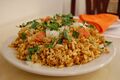 Indian cuisine Chaat Bhelpuri
 -
Indian Food Bhelpuri
-
Bhel puri chat, photographed in West Bengal, India

Advertise on WikiMD — 81,000+ full articles, ~900,000 total pages, ~250 million page views. Global reach, limited time promotional rates from $1/page/day. Learn more · View stats


Translate page: - East Asian
中文,
日本,
한국어,
South Asian
हिन्दी,
தமிழ்,
తెలుగు,
Urdu,
ಕನ್ನಡ,
Southeast Asian
Indonesian,
Vietnamese,
Thai,
မြန်မာဘာသာ,
বাংলা
European
español,
Deutsch,
français,
Greek,
português do Brasil,
polski,
română,
русский,
Nederlands,
norsk,
svenska,
suomi,
Italian
Middle Eastern & African
عربى,
Turkish,
Persian,
Hebrew,
Afrikaans,
isiZulu,
Kiswahili,
Other
Bulgarian,
Hungarian,
Czech,
Swedish,
മലയാളം,
मराठी,
ਪੰਜਾਬੀ,
ગુજરાતી,
Portuguese,
Ukrainian
About WikiMD • Contact • Disclaimer • Privacy • Copyright • Site statistics
Some content and images may originate from Wikimedia Commons or Wikipedia and remain subject to their stated licenses. Unless otherwise noted, eligible WikiMD content is available under CC BY-SA 4.0.
WikiMD Wellnesspedia — Free health & wellness information for patients, students, and health professionals.


