Banisteriopsis caapi
Banisteriopsis caapi is a tropical vine native to the Amazon rainforest, known for its significant role in traditional Amazonian shamanic practices. It is one of the primary ingredients in the sacred Ayahuasca brew, used for spiritual and healing purposes.
Taxonomy[edit]
The vine belongs to the family Malpighiaceae and was first described by the British botanist Richard Spruce in 1851. The genus Banisteriopsis was named after the English clergyman and botanist John Banister. The species name caapi originates from the Tupi language, in which it means "rope of the dead" or "vine of the soul".
Description[edit]
Banisteriopsis caapi is a large, woody vine that can grow up to 30 meters in length. The leaves are opposite, entire, and elliptic-oblong in shape. The flowers are small, white, and arranged in clusters. The fruit is a small, three-winged capsule.
Traditional Use[edit]
The vine is traditionally used by indigenous tribes of the Amazon for its psychoactive properties. The bark and stems are stripped and boiled with other plants, such as Psychotria viridis, to create the Ayahuasca brew. This brew is used in spiritual ceremonies for its visionary and healing effects.
Phytochemistry[edit]
The main active compounds in Banisteriopsis caapi are harmine, harmaline, and tetrahydroharmine. These compounds are Monoamine oxidase inhibitors (MAOIs), which allow the psychoactive compound DMT (found in Psychotria viridis) to be orally active.
Research[edit]
Research into Banisteriopsis caapi and Ayahuasca has increased in recent years, with studies investigating its potential therapeutic effects for conditions such as depression, anxiety, and addiction.
See Also[edit]
References[edit]

-
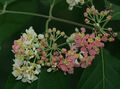 Banisteriopsis caapi in Teplice Botanical Garden


Medical Disclaimer: WikiMD is for informational purposes only and is not a substitute for professional medical advice. Content may be inaccurate or outdated and should not be used for diagnosis or treatment. Always consult your healthcare provider for medical decisions. Verify information with trusted sources such as CDC.gov and NIH.gov. By using this site, you agree that WikiMD is not liable for any outcomes related to its content. See full disclaimer.
Credits:Most images are courtesy of Wikimedia commons, and templates, categories Wikipedia, licensed under CC BY SA or similar.
Translate page: - East Asian
中文,
日本,
한국어,
South Asian
हिन्दी,
தமிழ்,
తెలుగు,
Urdu,
ಕನ್ನಡ,
Southeast Asian
Indonesian,
Vietnamese,
Thai,
မြန်မာဘာသာ,
বাংলা
European
español,
Deutsch,
français,
Greek,
português do Brasil,
polski,
română,
русский,
Nederlands,
norsk,
svenska,
suomi,
Italian
Middle Eastern & African
عربى,
Turkish,
Persian,
Hebrew,
Afrikaans,
isiZulu,
Kiswahili,
Other
Bulgarian,
Hungarian,
Czech,
Swedish,
മലയാളം,
मराठी,
ਪੰਜਾਬੀ,
ગુજરાતી,
Portuguese,
Ukrainian

