Badnavirus
Badnavirus is a genus of viruses in the family Caulimoviridae. Plants serve as natural hosts. There are currently 33 species in this genus including the type species Commelina yellow mottle virus. Diseases associated with this genus include: mosaic, mottle, streak, yellow mottle, and ringspot.
Taxonomy[edit]
The following species are recognized:
- Aglaonema mosaic virus
- Banana streak MY virus
- Banana streak OL virus
- Banana streak UA virus
- Banana streak UI virus
- Banana streak UM virus
- Banana streak virus
- Cacao swollen shoot CD virus
- Cacao swollen shoot CE virus
- Cacao swollen shoot Togo A virus
- Cacao swollen shoot Togo B virus
- Cacao swollen shoot virus
- Canna yellow mottle virus
- Canna yellow streak virus
- Commelina yellow mottle virus
- Dioscorea bacilliform AL virus
- Dioscorea bacilliform ES virus
- Dioscorea bacilliform RT virus
- Dioscorea bacilliform SN virus
- Dioscorea bacilliform TR virus
- Dioscorea bacilliform virus
- Dracaena mottle virus
- Fig badnavirus 1
- Gooseberry vein banding associated virus
- Grapevine vein clearing virus
- Pagoda yellow mottle associated virus
- Piper yellow mottle virus
- Rubus yellow net virus
- Sugarcane bacilliform Guadeloupe A virus
- Sugarcane bacilliform Guadeloupe D virus
- Sugarcane bacilliform IM virus
- Sugarcane bacilliform MO virus
- Sugarcane bacilliform virus
Structure[edit]
Viruses in Badnavirus are non-enveloped, with bacilliform geometries. The diameter is around 30 nm, with a length of 130 nm. Genomes are circular and non-segmented, around 7.2kb in length.
Life Cycle[edit]
Viral replication is nuclear. Entry into the host cell is achieved by penetration into the host cell. Replication follows the DNA strand displacement model. DNA-templated transcription is the method of transcription. The virus exits the host cell by nuclear pore export. Plants serve as the natural host. Transmission routes are mechanical.
References[edit]
External links[edit]

This WikiMD article can only be edited by registered and verified editors. You can log in or register.
[edit]
-
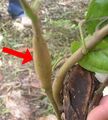 Cocoa Swollen Shoot Stem symptom

Advertise on WikiMD — 81,000+ full articles, ~900,000 total pages, ~250 million page views. Global reach, limited time promotional rates from $1/page/day. Learn more · View stats


Translate page: - East Asian
中文,
日本,
한국어,
South Asian
हिन्दी,
தமிழ்,
తెలుగు,
Urdu,
ಕನ್ನಡ,
Southeast Asian
Indonesian,
Vietnamese,
Thai,
မြန်မာဘာသာ,
বাংলা
European
español,
Deutsch,
français,
Greek,
português do Brasil,
polski,
română,
русский,
Nederlands,
norsk,
svenska,
suomi,
Italian
Middle Eastern & African
عربى,
Turkish,
Persian,
Hebrew,
Afrikaans,
isiZulu,
Kiswahili,
Other
Bulgarian,
Hungarian,
Czech,
Swedish,
മലയാളം,
मराठी,
ਪੰਜਾਬੀ,
ગુજરાતી,
Portuguese,
Ukrainian
About WikiMD • Contact • Disclaimer • Privacy • Copyright • Site statistics
Some content and images may originate from Wikimedia Commons or Wikipedia and remain subject to their stated licenses. Unless otherwise noted, eligible WikiMD content is available under CC BY-SA 4.0.
WikiMD Wellnesspedia — Free health & wellness information for patients, students, and health professionals.

