Bactrian camel
Bactrian Camel (Camelus bactrianus) is a large, even-toed ungulate native to the steppes of Central Asia. It is one of the two existing species of camel, the other being the dromedary or Arabian camel. The Bactrian camel is distinguished by its two humps, as opposed to the single hump of its cousin.
Characteristics[edit]
The Bactrian camel is a robust and hardy animal, capable of withstanding the harsh climates of the Central Asian steppes. It has a thick coat of hair, which it sheds in the warmer months, and a tough hide that protects it from the elements. The camel's two humps, which store fat, allow it to go for long periods without food or water.
Habitat and Distribution[edit]
The Bactrian camel is native to the steppes of Central Asia, including parts of China, Mongolia, and Kazakhstan. It is well adapted to the harsh desert conditions of this region, with its ability to withstand extreme temperatures and to go for long periods without water.
Diet[edit]
The Bactrian camel is a herbivore, feeding on a variety of plants in its desert habitat. It is also known to eat snow in the winter months as a source of water.
Conservation Status[edit]
The wild Bactrian camel is considered critically endangered by the International Union for Conservation of Nature (IUCN), with a population estimated at less than 1,000 individuals. The primary threats to the species are habitat loss due to mining and industrial development, and hunting for its meat and hide.
Domestication[edit]
The Bactrian camel has been domesticated for thousands of years and is used for transportation, milk, and meat by the people of Central Asia. The domesticated Bactrian camel is more numerous and has a wider distribution than its wild counterpart.
See Also[edit]
.png) | This article about a mammal is a stub. You can help WikiMD by expanding the page. |
Bactrian_camel[edit]
-
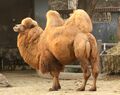 2011 Trampeltier 1528
 -
 Camel skeleton at MAV-USP
 -
 Bactrian camel (Camelus bactrianus)
 -
 Camelus bactrianus in western Mongolia 01
 -
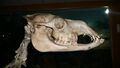 Camel skull 2
 -
 Babybactrian
 -
 Bactrian camel twice arp
 -
 Camel - panoramio (2)


.JPG)


.jpg)

Medical Disclaimer: WikiMD is for informational purposes only and is not a substitute for professional medical advice. Content may be inaccurate or outdated and should not be used for diagnosis or treatment. Always consult your healthcare provider for medical decisions. Verify information with trusted sources such as CDC.gov and NIH.gov. By using this site, you agree that WikiMD is not liable for any outcomes related to its content. See full disclaimer.
Credits:Most images are courtesy of Wikimedia commons, and templates, categories Wikipedia, licensed under CC BY SA or similar.
Translate page: - East Asian
中文,
日本,
한국어,
South Asian
हिन्दी,
தமிழ்,
తెలుగు,
Urdu,
ಕನ್ನಡ,
Southeast Asian
Indonesian,
Vietnamese,
Thai,
မြန်မာဘာသာ,
বাংলা
European
español,
Deutsch,
français,
Greek,
português do Brasil,
polski,
română,
русский,
Nederlands,
norsk,
svenska,
suomi,
Italian
Middle Eastern & African
عربى,
Turkish,
Persian,
Hebrew,
Afrikaans,
isiZulu,
Kiswahili,
Other
Bulgarian,
Hungarian,
Czech,
Swedish,
മലയാളം,
मराठी,
ਪੰਜਾਬੀ,
ગુજરાતી,
Portuguese,
Ukrainian

