Axotomy
Axotomy is a surgical procedure that involves the cutting or severing of an axon, the long threadlike part of a nerve cell along which impulses are conducted from the cell body to other cells. This procedure is often used in neuroscience research to study the process of nerve regeneration and neuroplasticity.
Procedure[edit]
The axotomy procedure is performed under a microscope to ensure precision. The surgeon uses a fine scalpel or laser to cut the axon. The procedure can be performed in vivo (in a living organism) or in vitro (outside a living organism, such as in a petri dish). The axon can be severed completely or partially, depending on the research objectives.
Applications[edit]
Axotomy is used in various fields of research, including neurobiology, neuropathology, and neuropharmacology. It is used to study the mechanisms of nerve injury and regeneration, the response of neurons to injury, and the effects of various drugs on nerve regeneration.
Effects[edit]
Following axotomy, the distal part of the axon (the part farthest from the cell body) undergoes Wallerian degeneration, a process in which the axon breaks down and is cleared away by glial cells. The proximal part of the axon (the part closest to the cell body) can then begin to regenerate and reestablish connections with its target cells.
Research[edit]
Research on axotomy has provided valuable insights into the mechanisms of nerve regeneration and the factors that influence this process. For example, studies have shown that the age of the organism, the type of neuron, and the distance to the target cells all affect the ability of the axon to regenerate after axotomy.
See also[edit]
 | This medical article is a stub. You can help WikiMD by expanding the page. |
Axotomy[edit]
-
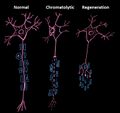 Axotomy


Medical Disclaimer: WikiMD is for informational purposes only and is not a substitute for professional medical advice. Content may be inaccurate or outdated and should not be used for diagnosis or treatment. Always consult your healthcare provider for medical decisions. Verify information with trusted sources such as CDC.gov and NIH.gov. By using this site, you agree that WikiMD is not liable for any outcomes related to its content. See full disclaimer.
Credits:Most images are courtesy of Wikimedia commons, and templates, categories Wikipedia, licensed under CC BY SA or similar.
Translate page: - East Asian
中文,
日本,
한국어,
South Asian
हिन्दी,
தமிழ்,
తెలుగు,
Urdu,
ಕನ್ನಡ,
Southeast Asian
Indonesian,
Vietnamese,
Thai,
မြန်မာဘာသာ,
বাংলা
European
español,
Deutsch,
français,
Greek,
português do Brasil,
polski,
română,
русский,
Nederlands,
norsk,
svenska,
suomi,
Italian
Middle Eastern & African
عربى,
Turkish,
Persian,
Hebrew,
Afrikaans,
isiZulu,
Kiswahili,
Other
Bulgarian,
Hungarian,
Czech,
Swedish,
മലയാളം,
मराठी,
ਪੰਜਾਬੀ,
ગુજરાતી,
Portuguese,
Ukrainian

