Averrhoa bilimbi
Averrhoa bilimbi (commonly known as bilimbi, cucumber tree, or tree sorrel) is a fruit-bearing tree of the genus Averrhoa, family Oxalidaceae. It is a close relative of the carambola tree.
Description[edit]
The Averrhoa bilimbi tree reaches heights of between 5 and 10 meters. The leaves, 30–60 cm in length, are alternate, imparipinnate and cluster at branch extremities. The flowers, small, fragrant, and yellowish-green or purplish marked with dark-purple, are borne in hairy panicles emerging directly from the trunk and oldest, stoutest branches. The fruit, classified as a berry, is ellipsoid, obovoid or nearly cylindrical, faintly 5-sided, 4 to 10 cm long.
Distribution and habitat[edit]
Averrhoa bilimbi is believed to be native to the Moluccas, but has been cultivated and naturalized in many parts of the world including throughout Southeast Asia, in Mauritius, Réunion, the Seychelles, many parts of Africa, South America, the Caribbean, Florida, and Hawaii.
Uses[edit]
The fruit is generally regarded as too acidic to be eaten raw, but is a common ingredient in many dishes. In the Philippines, the fruit is used in dishes such as sinigang and paksiw. It can also be used to make relishes and pickles. In Ayurveda, the fruit is used for its medicinal properties to treat a variety of ailments.
Cultivation[edit]
Averrhoa bilimbi is propagated by seeds, which remain viable for months. The tree grows best in well-drained, sandy loam or loamy soil, but is adaptable to any type of soil, including calcareous soil. It prefers a pH of 5.5 to 6.5, and high rainfall, but can withstand a long dry season.
See also[edit]
 | This fruit-related article is a stub. You can help WikiMD by expanding the page. |
Averrhoa_bilimbi[edit]
-
 Averrhoa bilimbi
 -
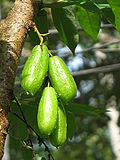 Averrhoa bilimbi fruit
 -
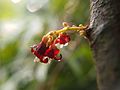 Averrhoa bilimbi flower
 -
 Averrhoa bilimbi flower
 -
 Javanese belimbing wuluh


Medical Disclaimer: WikiMD is for informational purposes only and is not a substitute for professional medical advice. Content may be inaccurate or outdated and should not be used for diagnosis or treatment. Always consult your healthcare provider for medical decisions. Verify information with trusted sources such as CDC.gov and NIH.gov. By using this site, you agree that WikiMD is not liable for any outcomes related to its content. See full disclaimer.
Credits:Most images are courtesy of Wikimedia commons, and templates, categories Wikipedia, licensed under CC BY SA or similar.
Translate this page: - East Asian
中文,
日本,
한국어,
South Asian
हिन्दी,
தமிழ்,
తెలుగు,
Urdu,
ಕನ್ನಡ,
Southeast Asian
Indonesian,
Vietnamese,
Thai,
မြန်မာဘာသာ,
বাংলা
European
español,
Deutsch,
français,
Greek,
português do Brasil,
polski,
română,
русский,
Nederlands,
norsk,
svenska,
suomi,
Italian
Middle Eastern & African
عربى,
Turkish,
Persian,
Hebrew,
Afrikaans,
isiZulu,
Kiswahili,
Other
Bulgarian,
Hungarian,
Czech,
Swedish,
മലയാളം,
मराठी,
ਪੰਜਾਬੀ,
ગુજરાતી,
Portuguese,
Ukrainian
