Artificial intelligence
Artificial Intelligence (AI) refers to the simulation of human intelligence in machines that are programmed to think like humans and mimic their actions. The term may also be applied to any machine that exhibits traits associated with a human mind such as learning and problem-solving.
Definition[edit]
The proper definition of artificial intelligence is often a subject of debate. However, it is generally accepted that any device that perceives its environment and takes actions to maximize its chance of successfully achieving its goals can be considered as having some form of AI.
History[edit]
The concept of artificial intelligence was first proposed by Alan Turing in the 1950s. He suggested that machines could be made to mimic human intelligence, and this idea has been developed and refined over the decades.
Types of AI[edit]
There are two types of AI: weak AI and strong AI. Weak AI, also known as narrow AI, is an AI system that is designed and trained for a particular task. In contrast, strong AI, also known as artificial general intelligence, is an AI system with generalized human cognitive abilities.
Applications[edit]
AI has been used in a wide range of fields including healthcare, robotics, finance, aviation, and education. It has the potential to perform tasks that are dangerous or tedious for humans, such as data analysis, prediction, and pattern recognition.
Ethics and Controversy[edit]
There are many ethical and societal concerns related to AI, such as job loss due to automation, privacy issues, and the potential misuse of AI technology.
Future of AI[edit]
The future of AI is uncertain and subject to much speculation. Some predict that AI will outperform humans in most economically valuable work within the next fifty years, while others believe that AI will not achieve human-level intelligence in the foreseeable future.
| Artificial Intelligence | ||||||||||
|---|---|---|---|---|---|---|---|---|---|---|
This artificial intelligence related article is a stub.
|
| Computer Science | ||||||||||
|---|---|---|---|---|---|---|---|---|---|---|
This Computer Science related article is a stub.
|
 | This technology-related article is a stub. You can help WikiMD by expanding the page. |
Artificial intelligence gallery[edit]
-
 General Formal Ontology
 -
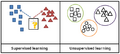 Supervised and unsupervised learning
 -
 Kismet
 -
 Gradient descent
 -
 Simple Bayes Net
 -
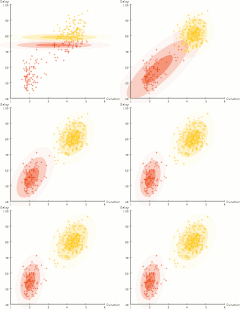 EM Clustering of Old Faithful data
 -
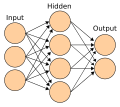 Artificial neural network
 -
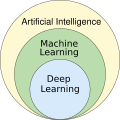 AI hierarchy
 -
Vincent van Gogh in watercolour
-
Vice President Harris at the group photo of the 2023 AI Safety Summit


Advertise on WikiMD — 81,000+ full articles, ~900,000 total pages, ~250 million page views. Global reach, limited time promotional rates from $1/page/day. Learn more · View stats


Translate page: - East Asian
中文,
日本,
한국어,
South Asian
हिन्दी,
தமிழ்,
తెలుగు,
Urdu,
ಕನ್ನಡ,
Southeast Asian
Indonesian,
Vietnamese,
Thai,
မြန်မာဘာသာ,
বাংলা
European
español,
Deutsch,
français,
Greek,
português do Brasil,
polski,
română,
русский,
Nederlands,
norsk,
svenska,
suomi,
Italian
Middle Eastern & African
عربى,
Turkish,
Persian,
Hebrew,
Afrikaans,
isiZulu,
Kiswahili,
Other
Bulgarian,
Hungarian,
Czech,
Swedish,
മലയാളം,
मराठी,
ਪੰਜਾਬੀ,
ગુજરાતી,
Portuguese,
Ukrainian
About WikiMD • Contact • Disclaimer • Privacy • Copyright • Site statistics
Some content and images may originate from Wikimedia Commons or Wikipedia and remain subject to their stated licenses. Unless otherwise noted, eligible WikiMD content is available under CC BY-SA 4.0.
WikiMD Wellnesspedia — Free health & wellness information for patients, students, and health professionals.


