Anatomy of the cerebellum
Overview of the anatomy of the cerebellum
The cerebellum is a major structure of the hindbrain that is located at the back of the cranial cavity, beneath the occipital lobes of the cerebrum and above the brainstem. It plays a crucial role in motor control, coordination, precision, and accurate timing of movements. The cerebellum is also involved in some cognitive functions such as attention and language, and in regulating fear and pleasure responses.
Structure[edit]
The cerebellum is divided into two hemispheres and has a highly folded surface, or cortex, which increases its surface area. The cerebellar cortex is composed of three layers: the outer molecular layer, the intermediate Purkinje cell layer, and the inner granular layer. Beneath the cortex lies the white matter, which contains the cerebellar nuclei.
Cerebellar Lobes[edit]
The cerebellum is divided into three lobes:
- The anterior lobe
- The posterior lobe
- The flocculonodular lobe
The anterior and posterior lobes are separated by the primary fissure, while the flocculonodular lobe is separated from the posterior lobe by the posterolateral fissure.
Cerebellar Nuclei[edit]
Embedded within the white matter of the cerebellum are the deep cerebellar nuclei, which include:
- The dentate nucleus
- The emboliform nucleus
- The globose nucleus
- The fastigial nucleus
These nuclei are the primary output centers of the cerebellum, sending signals to various parts of the brain and spinal cord.
Function[edit]
The cerebellum is primarily responsible for the coordination of voluntary movements. It receives input from sensory systems and other parts of the brain and spinal cord, and integrates these inputs to fine-tune motor activity. The cerebellum is also involved in motor learning, helping to adapt and refine movements through practice.
Connections[edit]
The cerebellum is connected to the rest of the brain via three pairs of cerebellar peduncles:
These peduncles contain the nerve fibers that carry information to and from the cerebellum.
Clinical Significance[edit]
Damage to the cerebellum can result in a variety of motor disorders, collectively known as cerebellar ataxia. Symptoms may include unsteady gait, difficulty with fine motor tasks, and problems with balance and coordination. Cerebellar damage can be caused by stroke, tumor, degenerative diseases, or trauma.
Gallery[edit]
-
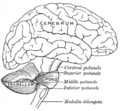 Anatomy of the cerebellum
 -
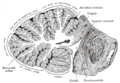 Anatomy of the cerebellum
 -
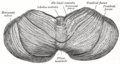 Anatomy of the cerebellum
 -
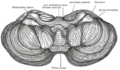 Anatomy of the cerebellum
 -
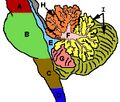 Anatomy of the cerebellum
 -
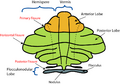 Anatomy of the cerebellum
 -
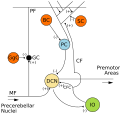 Anatomy of the cerebellum
 -
Anatomy of the cerebellum
-
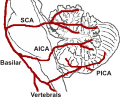 Anatomy of the cerebellum
 -
Anatomy of the cerebellum
-
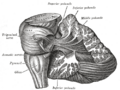 Anatomy of the cerebellum
 -
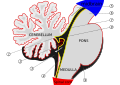 Anatomy of the cerebellum


Related Pages[edit]
Sponsored Health Resource

W8MD Weight Loss, Sleep & MedSpa
Looking for physician-supervised weight loss, semaglutide, tirzepatide, or GLP-1 receptor agonist options? W8MD helps eligible patients in New York City, Brooklyn, New Jersey, Connecticut, Pennsylvania, Delaware, and greater Philadelphia with medical weight loss, sleep medicine, and long-term maintenance support.
GLP-1 specials: Affordable GLP-1 injections NYC and Philadelphia starting from $29.99/week and up for semaglutide with insurance accepted for qualifying visits, and $45/week and up for tirzepatide with insurance accepted for qualifying visits. Self-pay options start from $59.99/week and up for semaglutide and $69.99/week and up for tirzepatide.
- Medical weight loss NYC
- Affordable GLP-1 injections NYC
- Budget GLP-1 weight loss shots Philadelphia
- New Jersey medical weight loss
- NYC medical weight loss blog
- Philadelphia weight loss blog
- Sleep medicine and sleep apnea services
- W8MD MedSpa and wellness
Book a W8MD appointment · View GLP-1 specials
Paid promotional message. Eligibility, pricing, insurance coverage, medication availability, and results vary. Medical evaluation required.

Medical Disclaimer: WikiMD is for informational purposes only and is not a substitute for professional medical advice. Content may be inaccurate or outdated and should not be used for diagnosis or treatment. Always consult your healthcare provider for medical decisions. Verify information with trusted sources such as CDC.gov and NIH.gov. By using this site, you agree that WikiMD is not liable for any outcomes related to its content. See full disclaimer.
Credits:Most images are courtesy of Wikimedia commons, and templates, categories Wikipedia, licensed under CC BY SA or similar.
Translate page: - East Asian
中文,
日本,
한국어,
South Asian
हिन्दी,
தமிழ்,
తెలుగు,
Urdu,
ಕನ್ನಡ,
Southeast Asian
Indonesian,
Vietnamese,
Thai,
မြန်မာဘာသာ,
বাংলা
European
español,
Deutsch,
français,
Greek,
português do Brasil,
polski,
română,
русский,
Nederlands,
norsk,
svenska,
suomi,
Italian
Middle Eastern & African
عربى,
Turkish,
Persian,
Hebrew,
Afrikaans,
isiZulu,
Kiswahili,
Other
Bulgarian,
Hungarian,
Czech,
Swedish,
മലയാളം,
मराठी,
ਪੰਜਾਬੀ,
ગુજરાતી,
Portuguese,
Ukrainian


