Aminoacetonitrile
Aminoacetonitrile is an organic compound with the formula NH2CH2CN. This colorless liquid is a valuable reagent in the synthesis of various organic compounds, including many biologically active compounds. It is derived from acetonitrile by nucleophilic substitution with ammonia, a process that exploits the high reactivity of the nitrile group.
Structure and properties[edit]
Aminoacetonitrile is a simple organic molecule with a linear structure. The molecule consists of a nitrile group (-CN) and an amino group (-NH2) attached to a central carbon atom. The nitrile group is a strong electron-withdrawing group, which makes the molecule polar and gives it a high dipole moment. The amino group, on the other hand, is a strong electron-donating group, which can form hydrogen bonds with other molecules.
Synthesis[edit]
Aminoacetonitrile can be synthesized from acetonitrile by nucleophilic substitution with ammonia. This reaction is typically carried out in a solvent such as ethanol or water, and may require the use of a catalyst to increase the reaction rate. The product is usually purified by distillation.
Applications[edit]
Aminoacetonitrile is a versatile reagent in organic synthesis. It can be used to prepare a wide range of biologically active compounds, including antibiotics, antiviral drugs, and antifungal agents. It is also used in the synthesis of amino acids, peptides, and proteins.
Safety[edit]
Aminoacetonitrile is a toxic compound and should be handled with care. It can cause irritation to the skin, eyes, and respiratory tract. Ingestion or inhalation of large amounts can lead to serious health effects, including damage to the nervous system and kidneys.
See also[edit]
 | This article about an organic compound is a stub. You can help WikiMD by expanding the page. |

 | This medical article is a stub. You can help WikiMD by expanding the page. |
Aminoacetonitrile gallery[edit]
-
 Aminoacetonitrile.svg
 -
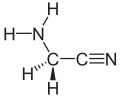 Aminoacetonitril.svg
 -
Aminoacetonitrile-3D-balls.png
-
Aminoacetonitrile-3D-spacefill.png


Medical Disclaimer: WikiMD is for informational purposes only and is not a substitute for professional medical advice. Content may be inaccurate or outdated and should not be used for diagnosis or treatment. Always consult your healthcare provider for medical decisions. Verify information with trusted sources such as CDC.gov and NIH.gov. By using this site, you agree that WikiMD is not liable for any outcomes related to its content. See full disclaimer.
Credits:Most images are courtesy of Wikimedia commons, and templates, categories Wikipedia, licensed under CC BY SA or similar.
Translate page: - East Asian
中文,
日本,
한국어,
South Asian
हिन्दी,
தமிழ்,
తెలుగు,
Urdu,
ಕನ್ನಡ,
Southeast Asian
Indonesian,
Vietnamese,
Thai,
မြန်မာဘာသာ,
বাংলা
European
español,
Deutsch,
français,
Greek,
português do Brasil,
polski,
română,
русский,
Nederlands,
norsk,
svenska,
suomi,
Italian
Middle Eastern & African
عربى,
Turkish,
Persian,
Hebrew,
Afrikaans,
isiZulu,
Kiswahili,
Other
Bulgarian,
Hungarian,
Czech,
Swedish,
മലയാളം,
मराठी,
ਪੰਜਾਬੀ,
ગુજરાતી,
Portuguese,
Ukrainian


