Alachlor
A herbicide used to control grasses and broadleaf weeds
| Chemical compounds | ||||||||
|---|---|---|---|---|---|---|---|---|
This chemical compound related article is a stub.
|
Alachlor is a widely used herbicide that is primarily applied to control annual grasses and broadleaf weeds in agriculture. It is particularly effective in corn, soybean, and peanut crops. Alachlor is a member of the chloroacetanilide family of herbicides.
Chemical properties[edit]
Alachlor is a chloroacetanilide herbicide with the chemical formula C14H20ClNO2. It is a systemic herbicide, meaning it is absorbed by the plant and translocated to the site of action. Alachlor works by inhibiting the synthesis of proteins and lipids, which are essential for plant growth.
Mode of action[edit]
Alachlor is absorbed by the roots and shoots of germinating seedlings. It inhibits the synthesis of very long chain fatty acids, which are crucial for cell division and growth. This action prevents the development of the meristematic tissue in the plant, leading to the death of the weed.
Usage[edit]
Alachlor is applied pre-emergence or pre-plant incorporated to control a wide range of annual grasses and broadleaf weeds. It is often used in combination with other herbicides to broaden the spectrum of weed control. The application rates and timing depend on the specific crop and weed species targeted.
Environmental impact[edit]
Alachlor has been detected in groundwater and surface water due to its mobility in soil. It is considered a potential carcinogen and has been subject to regulatory restrictions in several countries. The use of alachlor is carefully managed to minimize its environmental impact, including adherence to buffer zones and application guidelines.
Regulation[edit]
The use of alachlor is regulated by various environmental agencies, including the United States Environmental Protection Agency (EPA). It is classified as a restricted use pesticide in the United States, meaning it can only be applied by certified applicators.
Health effects[edit]
Exposure to alachlor can occur through inhalation, skin contact, or ingestion. It may cause irritation to the skin and eyes, and prolonged exposure has been linked to more serious health effects, including cancer. Safety measures, such as wearing protective clothing and equipment, are recommended when handling alachlor.
Related pages[edit]
Gallery[edit]
-
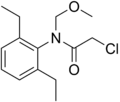 Chemical structure of alachlor
 -
 3D space-filling model of alachlor
 -
 Monsanto's Lasso herbicide containing alachlor


.jpg)
Alachlor[edit]

Medical Disclaimer: WikiMD is for informational purposes only and is not a substitute for professional medical advice. Content may be inaccurate or outdated and should not be used for diagnosis or treatment. Always consult your healthcare provider for medical decisions. Verify information with trusted sources such as CDC.gov and NIH.gov. By using this site, you agree that WikiMD is not liable for any outcomes related to its content. See full disclaimer.
Credits:Most images are courtesy of Wikimedia commons, and templates, categories Wikipedia, licensed under CC BY SA or similar.
Translate page: - East Asian
中文,
日本,
한국어,
South Asian
हिन्दी,
தமிழ்,
తెలుగు,
Urdu,
ಕನ್ನಡ,
Southeast Asian
Indonesian,
Vietnamese,
Thai,
မြန်မာဘာသာ,
বাংলা
European
español,
Deutsch,
français,
Greek,
português do Brasil,
polski,
română,
русский,
Nederlands,
norsk,
svenska,
suomi,
Italian
Middle Eastern & African
عربى,
Turkish,
Persian,
Hebrew,
Afrikaans,
isiZulu,
Kiswahili,
Other
Bulgarian,
Hungarian,
Czech,
Swedish,
മലയാളം,
मराठी,
ਪੰਜਾਬੀ,
ગુજરાતી,
Portuguese,
Ukrainian

