Absent adrenal gland
| Absent Adrenal Gland | |
|---|---|
| Synonyms | N/A |
| Pronounce | N/A |
| Specialty | N/A |
| Symptoms | Adrenal insufficiency, hypotension, hypoglycemia |
| Complications | Adrenal crisis |
| Onset | Congenital |
| Duration | Lifelong |
| Types | N/A |
| Causes | Congenital adrenal hyperplasia, genetic mutations |
| Risks | N/A |
| Diagnosis | Imaging studies, hormonal assays |
| Differential diagnosis | N/A |
| Prevention | N/A |
| Treatment | Hormone replacement therapy |
| Medication | N/A |
| Prognosis | N/A |
| Frequency | Rare |
| Deaths | N/A |
The absent adrenal gland is a rare congenital condition characterized by the complete absence of one or both adrenal glands. The adrenal glands are small, triangular-shaped glands located on top of each kidney. They are responsible for producing essential hormones such as cortisol, aldosterone, and adrenaline.
Causes[edit]
The absence of adrenal glands can be due to several factors, including:
- Congenital adrenal hyperplasia: A group of genetic disorders affecting adrenal gland development.
- Genetic mutations: Mutations in genes responsible for adrenal gland formation can lead to their absence.
- Developmental anomalies: Issues during fetal development can result in the absence of adrenal glands.
Symptoms[edit]
Individuals with absent adrenal glands may experience symptoms related to adrenal insufficiency, such as:
- Hypotension (low blood pressure)
- Hypoglycemia (low blood sugar levels)
- Fatigue
- Muscle weakness
- Weight loss
Complications[edit]
A significant complication of absent adrenal glands is the risk of an adrenal crisis, a life-threatening condition that requires immediate medical attention. Symptoms of an adrenal crisis include severe vomiting, diarrhea, dehydration, and shock.
Diagnosis[edit]
Diagnosis of absent adrenal glands typically involves:
- Imaging studies: Such as ultrasound or MRI to visualize the adrenal glands.
- Hormonal assays: Blood tests to measure levels of adrenal hormones.
Treatment[edit]
The primary treatment for absent adrenal glands is hormone replacement therapy to compensate for the hormones that the adrenal glands would normally produce. This may include:
- Glucocorticoids (e.g., hydrocortisone)
- Mineralocorticoids (e.g., fludrocortisone)
See also[edit]
References[edit]
External links[edit]
-
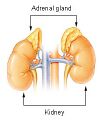 Absent adrenal gland


Medical Disclaimer: WikiMD is for informational purposes only and is not a substitute for professional medical advice. Content may be inaccurate or outdated and should not be used for diagnosis or treatment. Always consult your healthcare provider for medical decisions. Verify information with trusted sources such as CDC.gov and NIH.gov. By using this site, you agree that WikiMD is not liable for any outcomes related to its content. See full disclaimer.
Credits:Most images are courtesy of Wikimedia commons, and templates, categories Wikipedia, licensed under CC BY SA or similar.
Translate page: - East Asian
中文,
日本,
한국어,
South Asian
हिन्दी,
தமிழ்,
తెలుగు,
Urdu,
ಕನ್ನಡ,
Southeast Asian
Indonesian,
Vietnamese,
Thai,
မြန်မာဘာသာ,
বাংলা
European
español,
Deutsch,
français,
Greek,
português do Brasil,
polski,
română,
русский,
Nederlands,
norsk,
svenska,
suomi,
Italian
Middle Eastern & African
عربى,
Turkish,
Persian,
Hebrew,
Afrikaans,
isiZulu,
Kiswahili,
Other
Bulgarian,
Hungarian,
Czech,
Swedish,
മലയാളം,
मराठी,
ਪੰਜਾਬੀ,
ગુજરાતી,
Portuguese,
Ukrainian

