Abortion in Europe
Abortion in Europe refers to the termination of pregnancy through medical or surgical means. The legality, prevalence, and cultural attitudes towards abortion vary significantly across European countries. Abortion laws in Europe range from highly restrictive to relatively liberal, influencing the accessibility and acceptability of abortion services within each country.
Legality[edit]
The legal status of abortion in Europe is diverse. Countries such as Malta and the Vatican City have strict laws, prohibiting abortion under almost all circumstances. In contrast, nations like Sweden, Netherlands, and Finland have more liberal laws, allowing abortion on request or broad social grounds. Central and Eastern European countries, including Poland and Hungary, have seen debates and changes in abortion laws, reflecting broader political and social dynamics.
Access and Services[edit]
Access to abortion services in Europe is influenced by legal frameworks, healthcare infrastructure, and societal attitudes. In countries with liberal laws, such as the United Kingdom and France, abortion services are widely available and integrated into the healthcare system. However, in countries with restrictive laws or where societal stigma is significant, women may face challenges accessing safe and legal abortion services, leading to issues of inequality and health risks.
Cultural and Societal Attitudes[edit]
Cultural and societal attitudes towards abortion in Europe are varied and can significantly impact women's rights and health. In some countries, there is broad public support for reproductive rights, including the right to choose an abortion. In others, cultural, religious, and political factors contribute to a more conservative stance on abortion, often leading to stigma and silence around the issue.
International and European Union Perspectives[edit]
The European Union (EU) does not have a unified policy on abortion, as healthcare is primarily a national competence. However, the EU promotes women's rights and access to healthcare, including reproductive health services, through various policies and funding mechanisms. International organizations, such as the World Health Organization (WHO), also play a role in advocating for safe and accessible abortion services as part of comprehensive reproductive health care.
Recent Developments[edit]
Recent years have seen significant developments in abortion laws and debates in Europe. For example, Ireland's 2018 referendum resulted in the legalization of abortion, marking a significant shift in the country's approach to reproductive rights. Similarly, changes in legislation and public debates in countries like Poland have highlighted the ongoing contention and activism surrounding abortion rights.
Images[edit]
-
 Russian Abortion Poster
 -
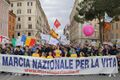 Manifestazione pro-vita


 | This medical article is a stub. You can help WikiMD by expanding the page. |

Medical Disclaimer: WikiMD is for informational purposes only and is not a substitute for professional medical advice. Content may be inaccurate or outdated and should not be used for diagnosis or treatment. Always consult your healthcare provider for medical decisions. Verify information with trusted sources such as CDC.gov and NIH.gov. By using this site, you agree that WikiMD is not liable for any outcomes related to its content. See full disclaimer.
Credits:Most images are courtesy of Wikimedia commons, and templates, categories Wikipedia, licensed under CC BY SA or similar.
Translate page: - East Asian
中文,
日本,
한국어,
South Asian
हिन्दी,
தமிழ்,
తెలుగు,
Urdu,
ಕನ್ನಡ,
Southeast Asian
Indonesian,
Vietnamese,
Thai,
မြန်မာဘာသာ,
বাংলা
European
español,
Deutsch,
français,
Greek,
português do Brasil,
polski,
română,
русский,
Nederlands,
norsk,
svenska,
suomi,
Italian
Middle Eastern & African
عربى,
Turkish,
Persian,
Hebrew,
Afrikaans,
isiZulu,
Kiswahili,
Other
Bulgarian,
Hungarian,
Czech,
Swedish,
മലയാളം,
मराठी,
ਪੰਜਾਬੀ,
ગુજરાતી,
Portuguese,
Ukrainian

