Humerus fracture

Editor-In-Chief: Prab R Tumpati, MD
Obesity, Sleep & Internal medicine
Founder, WikiMD Wellnesspedia &
W8MD's weight loss doctor NYC
Philadelphia GLP-1 weight loss and GLP-1 clinic NYC
| Humerus fracture | |
|---|---|
 | |
| Synonyms | Fracture of the humerus |
| Pronounce | N/A |
| Specialty | N/A |
| Symptoms | Pain, swelling, bruising, deformity of the upper arm |
| Complications | Nerve injury, vascular injury, nonunion, malunion |
| Onset | Sudden, following trauma |
| Duration | Weeks to months, depending on severity and treatment |
| Types | Proximal humerus fracture, midshaft humerus fracture, distal humerus fracture |
| Causes | Trauma, fall, direct blow, osteoporosis |
| Risks | Osteoporosis, advanced age, high-impact sports |
| Diagnosis | Physical examination, X-ray, CT scan |
| Differential diagnosis | Shoulder dislocation, biceps tendon rupture, rotator cuff tear |
| Prevention | N/A |
| Treatment | Immobilization, surgery, physical therapy |
| Medication | Pain management, anti-inflammatory drugs |
| Prognosis | Generally good with appropriate treatment |
| Frequency | Common, especially in older adults |
| Deaths | N/A |
.jpg)


A Humerus Fracture is a break in the large bone of the upper arm, the humerus. This type of fracture can occur in any part of the humerus, including the ends near the shoulder and the elbow.
Types of Humerus Fractures[edit]
There are three main types of humerus fractures based on the location of the fracture:
- Proximal Humerus Fractures: These fractures occur at the top of the humerus, near the shoulder. They are most common in older people with osteoporosis.
- Midshaft Humerus Fractures: These fractures occur in the middle of the humerus. They can happen to anyone, but are often the result of a direct blow or fall.
- Distal Humerus Fractures: These fractures occur at the end of the humerus, near the elbow. They are relatively rare and usually the result of a direct blow or fall.
Causes[edit]
Humerus fractures are typically caused by a direct blow to the arm, a fall onto an outstretched arm, or a violent twisting of the arm. Certain medical conditions, such as osteoporosis or bone cancer, can weaken the humerus and make it more susceptible to fracture.
Symptoms[edit]
The most common symptoms of a humerus fracture include severe pain, swelling, bruising, and inability to move the arm. In some cases, there may be a visible deformity or the bone may even protrude through the skin.
Treatment[edit]
Treatment for a humerus fracture depends on the location and severity of the fracture. Non-surgical treatments include immobilization with a cast or splint, pain medication, and physical therapy. Surgical treatments may be necessary for more severe fractures and can include internal fixation, where hardware is used to hold the bone in place, or joint replacement.
Additional images[edit]
-
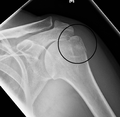 Trochanter Fracture
 -
 Proximal Humeral Fracture
 -
 Proximal Humerus Fracture
 -
 Mid Shaft Humerus Mark
 -
 Spiral Fracture


See Also[edit]
 | This medical article is a stub. You can help WikiMD by expanding the page. |
Medical Disclaimer: WikiMD is for informational purposes only and is not a substitute for professional medical advice. Content may be inaccurate or outdated and should not be used for diagnosis or treatment. Always consult your healthcare provider for medical decisions. Verify information with trusted sources such as CDC.gov and NIH.gov. By using this site, you agree that WikiMD is not liable for any outcomes related to its content. See full disclaimer.
Credits:Most images are courtesy of Wikimedia commons, and templates, categories Wikipedia, licensed under CC BY SA or similar.
Translate this page: - East Asian
中文,
日本,
한국어,
South Asian
हिन्दी,
தமிழ்,
తెలుగు,
Urdu,
ಕನ್ನಡ,
Southeast Asian
Indonesian,
Vietnamese,
Thai,
မြန်မာဘာသာ,
বাংলা
European
español,
Deutsch,
français,
Greek,
português do Brasil,
polski,
română,
русский,
Nederlands,
norsk,
svenska,
suomi,
Italian
Middle Eastern & African
عربى,
Turkish,
Persian,
Hebrew,
Afrikaans,
isiZulu,
Kiswahili,
Other
Bulgarian,
Hungarian,
Czech,
Swedish,
മലയാളം,
मराठी,
ਪੰਜਾਬੀ,
ગુજરાતી,
Portuguese,
Ukrainian
