Self-determination
Self-determination is a principle in international law and political philosophy that pertains to the right of peoples to determine their own destiny and govern themselves. In the context of international relations, it supports the idea that nations, peoples, or nationalities have the right to choose their own government, free from external interference. This concept is closely linked to the principles of sovereignty and non-intervention.
History[edit]
The concept of self-determination has evolved significantly over time. Its modern formulation can be traced back to the American and French Revolutions in the late 18th century. However, it was not until the aftermath of World War I and the dissolution of empires that self-determination became a central issue in international politics. Woodrow Wilson, the 28th President of the United States, played a crucial role in promoting the idea of self-determination as part of his Fourteen Points for peace after World War I. The establishment of the League of Nations marked the first international attempt to acknowledge and implement the principle of self-determination on a wide scale.
Self-determination in International Law[edit]
In international law, self-determination is a right recognized for all peoples. It is enshrined in several key documents, including the Charter of the United Nations and the International Covenant on Civil and Political Rights (ICCPR), as well as the International Covenant on Economic, Social and Cultural Rights (ICESCR). These documents assert that all peoples have the right to freely determine their political status and freely pursue their economic, social, and cultural development.
Contemporary Issues[edit]
In contemporary times, the application of self-determination has extended to include not only the formation of independent states but also the right to autonomy or self-governance within existing states. This has led to a variety of movements around the world, from calls for independence in regions such as Catalonia and Kurdistan, to demands for greater autonomy by indigenous groups and minorities.
The principle of self-determination also intersects with other international issues, including decolonization, human rights, and democracy. However, the application of self-determination can be complex and contentious, particularly when it comes to defining a "people" entitled to self-determination and balancing this right with the principles of territorial integrity and sovereignty of states.
Challenges and Criticisms[edit]
One of the main challenges in applying the principle of self-determination is the potential for conflict with the existing state boundaries and the principle of territorial integrity. Additionally, there is often debate over who constitutes a "people" for the purposes of self-determination. These issues can lead to internal and international conflicts, secessionist movements, and challenges in implementing the right to self-determination in a manner that respects the rights and interests of all parties involved.
Conclusion[edit]
Self-determination remains a fundamental yet complex principle in international relations and law. While it underpins the right of peoples to govern themselves and decide their own future, its application must be balanced with other principles of international law and the realities of the global political landscape.

-
 Zuid-Molukkers demonstreren bij Indonesische Ambassade in Den Haag tegen schending
 -
 Map Europe 1923
 -
 Decolonization - World In 1945
 -
 Colonization 1945
 -
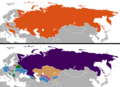 Cold War border changes
 -
 South Sudan Independence Celebration
 -
 Kosova independence Vienna 17-02-2008
 -
 Referendum in Donetsk 2014
 -
 Hong Kong protest 2019
 -
 Artsakh Movement, February 13, 1988


.jpg)


.jpg)

Ad. Transform your life with W8MD's
GLP-1 weight loss injections special from $29.99 with insurance
|
WikiMD Medical Encyclopedia |
Medical Disclaimer: WikiMD is for informational purposes only and is not a substitute for professional medical advice. Content may be inaccurate or outdated and should not be used for diagnosis or treatment. Always consult your healthcare provider for medical decisions. Verify information with trusted sources such as CDC.gov and NIH.gov. By using this site, you agree that WikiMD is not liable for any outcomes related to its content. See full disclaimer.
Credits:Most images are courtesy of Wikimedia commons, and templates, categories Wikipedia, licensed under CC BY SA or similar.
Translate this page: - East Asian
中文,
日本,
한국어,
South Asian
हिन्दी,
தமிழ்,
తెలుగు,
Urdu,
ಕನ್ನಡ,
Southeast Asian
Indonesian,
Vietnamese,
Thai,
မြန်မာဘာသာ,
বাংলা
European
español,
Deutsch,
français,
Greek,
português do Brasil,
polski,
română,
русский,
Nederlands,
norsk,
svenska,
suomi,
Italian
Middle Eastern & African
عربى,
Turkish,
Persian,
Hebrew,
Afrikaans,
isiZulu,
Kiswahili,
Other
Bulgarian,
Hungarian,
Czech,
Swedish,
മലയാളം,
मराठी,
ਪੰਜਾਬੀ,
ગુજરાતી,
Portuguese,
Ukrainian
