Méchoui
Méchoui is a traditional North African and Arab dish. The term 'Méchoui' originates from the Arabic word 'Shawa', which means 'grilled' or 'roasted' on an open fire. This dish is typically prepared using a whole sheep or a lamb that is slow-roasted on a spit over an open fire or in a special oven.
History[edit]
The tradition of Méchoui dates back to ancient times and is deeply rooted in the culinary traditions of the Berber and Arab communities. It is often prepared for large gatherings, special occasions, and religious festivals such as Eid al-Adha, also known as the 'Festival of Sacrifice'.
Preparation[edit]
The preparation of Méchoui involves marinating the whole sheep or lamb in a mixture of spices, including garlic, cumin, coriander, paprika, salt, and pepper. The marinated meat is then slow-roasted on a spit over an open fire for several hours until it becomes tender and the skin turns crispy. The meat is traditionally served with couscous, bread, and a variety of salads.
Regional Variations[edit]
While Méchoui is a common dish across North Africa and the Arab world, there are regional variations in its preparation and serving. In Morocco, for example, the meat is often stuffed with a mixture of rice, onion, and spices before roasting. In Algeria, Méchoui is typically served with a spicy sauce made from chili peppers, garlic, and coriander.
Cultural Significance[edit]
Méchoui holds a significant place in North African and Arab cultures. It is not just a dish, but a social event that brings families and communities together. The process of preparing and cooking Méchoui is often a communal activity, with everyone participating in the various stages of preparation and cooking.

Méchoui[edit]
-
 Méchoui
 -
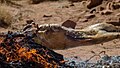 Méchoui sur le feu du bois à Aflou
 -
 Méchoui


Ad. Transform your life with W8MD's
GLP-1 weight loss injections special from $29.99 with insurance
|
WikiMD Medical Encyclopedia |
Medical Disclaimer: WikiMD is for informational purposes only and is not a substitute for professional medical advice. Content may be inaccurate or outdated and should not be used for diagnosis or treatment. Always consult your healthcare provider for medical decisions. Verify information with trusted sources such as CDC.gov and NIH.gov. By using this site, you agree that WikiMD is not liable for any outcomes related to its content. See full disclaimer.
Credits:Most images are courtesy of Wikimedia commons, and templates, categories Wikipedia, licensed under CC BY SA or similar.
Translate this page: - East Asian
中文,
日本,
한국어,
South Asian
हिन्दी,
தமிழ்,
తెలుగు,
Urdu,
ಕನ್ನಡ,
Southeast Asian
Indonesian,
Vietnamese,
Thai,
မြန်မာဘာသာ,
বাংলা
European
español,
Deutsch,
français,
Greek,
português do Brasil,
polski,
română,
русский,
Nederlands,
norsk,
svenska,
suomi,
Italian
Middle Eastern & African
عربى,
Turkish,
Persian,
Hebrew,
Afrikaans,
isiZulu,
Kiswahili,
Other
Bulgarian,
Hungarian,
Czech,
Swedish,
മലയാളം,
मराठी,
ਪੰਜਾਬੀ,
ગુજરાતી,
Portuguese,
Ukrainian
