Ketchup

| |
| A bottle of ketchup | |
| Alternative names | Catsup, Tomato Sauce |
| Type | Condiment |
| Course | |
| Place of origin | |
| Region or state | |
| Associated national cuisine | |
| Created by | |
| Invented | |
| Cooking time | minutes to minutes |
| Serving temperature | |
| Main ingredients | Tomatoes, Vinegar, Sugar, Salt, Spices |
| Ingredients generally used | |
| Variations | Curry ketchup, Mushroom ketchup, Banana ketchup |
| Food energy | 100 kcal |
| Nutritional value | Protein: g, Fat: g, Carbohydrate: g |
| Glycemic index | |
| Similar dishes | |
| Other information | |
| Website | [ Official website] |
Ketchup is a sauce or condiment made primarily from tomatoes, vinegar, sugar, and salt, with a variety of spices and seasonings. It is widely used in many countries and is a staple condiment in American cuisine, often accompanying dishes such as french fries, hamburgers, and hot dogs.
History
The history of ketchup is a long and varied one, with its origins tracing back to East Asia. The word "ketchup" is believed to have been derived from the Chinese word "ke-tsiap", a brine of pickled fish. In the 17th century, this sauce made its way to Malaysia and Singapore, where it was called "kicap" or "kecap". English explorers encountered it in the late 17th century and brought it back to Europe, where it underwent several transformations, eventually leading to the tomato-based version we are familiar with today.
Varieties
There are several varieties of ketchup, including:
- Curry ketchup: Popular in Germany, it is a spicier version of the traditional ketchup, mixed with curry powder.
- Mushroom ketchup: A historic British recipe, this version uses mushrooms instead of tomatoes as the primary ingredient.
- Banana ketchup: Invented in the Philippines, this variety uses bananas as a base, offering a sweeter taste.
Production
The production of ketchup involves the blending of its main ingredients - tomatoes, vinegar, sugar, salt, and a mix of spices and flavorings. The tomatoes are cooked down to reduce their water content and concentrate their flavors. The mixture is then strained to remove any solids, resulting in a smooth, thick sauce. Finally, the ketchup is pasteurized to ensure its shelf stability.
Cultural Significance
Ketchup holds a significant place in American culture, often considered the quintessential American condiment. It is a common sight at picnics, barbecues, and diner tables across the country. Its popularity has also spread globally, making it one of the most consumed condiments in the world.
Health Aspects
While ketchup is low in fat and calories, it is high in sugar and sodium, which can be a concern for individuals monitoring their intake of these substances. Some brands offer reduced-sugar or reduced-salt versions to cater to health-conscious consumers.
See Also

-
 Homemade mushroom ketchup
 -
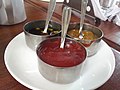 Different types of ketchup on a plate
 -
 Tomato ketchup
 -
 Blue Label Ketchup, 1898
 -
 Pouring ketchup at Elmo's Diner
 -
Ketchup
_-_(cropped).jpg)


-
 Ketchup
.jpg)
Ad. Transform your life with W8MD's
GLP-1 weight loss injections special from $29.99 with insurance
|
WikiMD Medical Encyclopedia |
Medical Disclaimer: WikiMD is for informational purposes only and is not a substitute for professional medical advice. Content may be inaccurate or outdated and should not be used for diagnosis or treatment. Always consult your healthcare provider for medical decisions. Verify information with trusted sources such as CDC.gov and NIH.gov. By using this site, you agree that WikiMD is not liable for any outcomes related to its content. See full disclaimer.
Credits:Most images are courtesy of Wikimedia commons, and templates, categories Wikipedia, licensed under CC BY SA or similar.
Translate this page: - East Asian
中文,
日本,
한국어,
South Asian
हिन्दी,
தமிழ்,
తెలుగు,
Urdu,
ಕನ್ನಡ,
Southeast Asian
Indonesian,
Vietnamese,
Thai,
မြန်မာဘာသာ,
বাংলা
European
español,
Deutsch,
français,
Greek,
português do Brasil,
polski,
română,
русский,
Nederlands,
norsk,
svenska,
suomi,
Italian
Middle Eastern & African
عربى,
Turkish,
Persian,
Hebrew,
Afrikaans,
isiZulu,
Kiswahili,
Other
Bulgarian,
Hungarian,
Czech,
Swedish,
മലയാളം,
मराठी,
ਪੰਜਾਬੀ,
ગુજરાતી,
Portuguese,
Ukrainian

