Baghdad


_p008_View_of_Bagdad_on_the_Persian_side_of_the_Tigris.jpg)


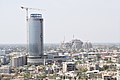
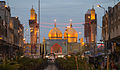
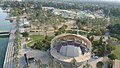
Baghdad is the capital and largest city of Iraq, as well as one of the largest cities in the Arab world. Located along the Tigris River, the city was founded in the 8th century and has since been a significant cultural, commercial, and intellectual center of the Arab world. This article provides an overview of Baghdad's history, geography, demographics, and cultural significance.
History[edit]
The foundation of Baghdad dates back to the Islamic Golden Age, under the Abbasid Caliphate, when Caliph Al-Mansur commissioned the construction of the city in 762 AD. It was designed as a round city, known as the "City of Peace" (Madīnat al-Salām), and quickly became a prominent center for learning, with the establishment of the House of Wisdom and numerous libraries, observatories, and schools. Baghdad's strategic location along trade routes contributed to its prosperity and growth but also made it a target for invasions. Over the centuries, it was captured by the Mongols, the Ottoman Empire, and most recently, occupied during the Iraq War.
Geography[edit]
Baghdad is situated in the center of Iraq, on the banks of the Tigris River. The city is divided into two main parts: the eastern section called "Risafa" and the western part known as "Karkh." The Green Zone is a heavily fortified area in the Karkh district, which has been the location of major governmental and international institutions.
Demographics[edit]
The population of Baghdad is diverse, comprising mainly Arabs, but also includes Kurds, Turkmens, and other ethnic groups. The predominant religion is Islam, with a majority of the population being Shia Muslims, followed by a significant number of Sunni Muslims.
Culture[edit]
Baghdad has been a center of Arabic literature and poetry for centuries. The city's cultural institutions, like the National Museum of Iraq, house precious artifacts that span 6,000 years of civilization in the region. Despite the challenges of recent decades, Baghdad continues to be a hub for Iraqi culture and arts.
Economy[edit]
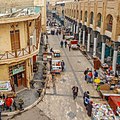
Historically, Baghdad played a crucial role in the Silk Road trade and was known for its skilled craftsmen and bustling markets. Today, the city's economy is primarily based on the oil industry, with Iraq being one of the world's leading oil producers. Reconstruction efforts and foreign investment have been vital in rebuilding the city's infrastructure and economy post-conflict.
Education[edit]
Baghdad is home to several of Iraq's largest universities, including the University of Baghdad, which has been a leading center of higher education and research in the Middle East since its establishment in 1957.
Challenges[edit]
The city has faced significant challenges in recent decades, including infrastructure damage from wars, terrorism, and sectarian violence. Efforts to rebuild Baghdad and restore its historic sites are ongoing, with a focus on promoting peace and stability in the region.
Conclusion[edit]
Baghdad's rich history and cultural heritage, combined with its strategic importance in the Arab world, make it a city of significant interest. Despite the challenges it has faced, Baghdad remains a symbol of resilience and cultural pride for the Iraqi people.

-
 Baghdad
 -
 Baghdad
 -
 Baghdad
 -
 Baghdad
 -
 Baghdad
 -
 Baghdad
 -
 Baghdad
 -
 Baghdad


Ad. Transform your health with W8MD Weight Loss, Sleep & MedSpa

Tired of being overweight?
Special offer:
Budget GLP-1 weight loss medications
- Semaglutide starting from $29.99/week and up with insurance for visit of $59.99 and up per week self pay.
- Tirzepatide starting from $45.00/week and up (dose dependent) or $69.99/week and up self pay
✔ Same-week appointments, evenings & weekends
Learn more:
- GLP-1 weight loss clinic NYC
- W8MD's NYC medical weight loss
- W8MD Philadelphia GLP-1 shots
- Philadelphia GLP-1 injections
- Affordable GLP-1 shots NYC
|
WikiMD Medical Encyclopedia |
Medical Disclaimer: WikiMD is for informational purposes only and is not a substitute for professional medical advice. Content may be inaccurate or outdated and should not be used for diagnosis or treatment. Always consult your healthcare provider for medical decisions. Verify information with trusted sources such as CDC.gov and NIH.gov. By using this site, you agree that WikiMD is not liable for any outcomes related to its content. See full disclaimer.
Credits:Most images are courtesy of Wikimedia commons, and templates, categories Wikipedia, licensed under CC BY SA or similar.
Translate this page: - East Asian
中文,
日本,
한국어,
South Asian
हिन्दी,
தமிழ்,
తెలుగు,
Urdu,
ಕನ್ನಡ,
Southeast Asian
Indonesian,
Vietnamese,
Thai,
မြန်မာဘာသာ,
বাংলা
European
español,
Deutsch,
français,
Greek,
português do Brasil,
polski,
română,
русский,
Nederlands,
norsk,
svenska,
suomi,
Italian
Middle Eastern & African
عربى,
Turkish,
Persian,
Hebrew,
Afrikaans,
isiZulu,
Kiswahili,
Other
Bulgarian,
Hungarian,
Czech,
Swedish,
മലയാളം,
मराठी,
ਪੰਜਾਬੀ,
ગુજરાતી,
Portuguese,
Ukrainian
