Spindle apparatus
Spindle apparatus is a cellular structure that plays a crucial role during cell division, specifically during mitosis and meiosis. It is responsible for the segregation of chromosomes into two daughter cells, ensuring that each daughter cell receives an identical set of chromosomes. The spindle apparatus is composed of microtubules, which are dynamic filamentous structures that can grow and shrink, motor proteins, and various other molecules that regulate its function.
Structure and Function[edit]
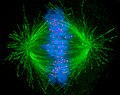
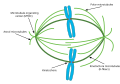
The spindle apparatus is primarily made up of microtubules, which originate from structures called centrosomes in animal cells or spindle pole bodies in fungal and plant cells. These microtubules can be categorized into three main types based on their interactions with chromosomes and the centrosomes: kinetochore microtubules, polar microtubules, and astral microtubules.
- Kinetochore microtubules attach to a region on the chromosome called the kinetochore, directly facilitating the movement of chromosomes.
- Polar microtubules extend from each spindle pole and interact with those from the opposite pole, helping to push the poles apart and elongate the cell.
- Astral microtubules anchor the spindle poles to the cell membrane, assisting in the positioning of the spindle apparatus.
The spindle apparatus is essential for the accurate segregation of chromosomes. During mitosis and meiosis, the chromosomes are aligned at the spindle equator, forming the metaphase plate. The kinetochore microtubules then pull the chromosomes apart, ensuring that each daughter cell receives an identical set of chromosomes.
Regulation[edit]
The assembly and function of the spindle apparatus are tightly regulated by various cell cycle checkpoints, particularly the spindle assembly checkpoint. This checkpoint ensures that all chromosomes are properly attached to the spindle apparatus before the cell proceeds with chromosome segregation. Various proteins, including cyclin-dependent kinases (CDKs) and Aurora kinases, play critical roles in the regulation of spindle assembly and function.
Clinical Significance[edit]
Abnormalities in the spindle apparatus can lead to improper chromosome segregation, resulting in aneuploidy, a condition where cells have an abnormal number of chromosomes. Aneuploidy is associated with various diseases, including cancer and several genetic disorders. Therefore, understanding the spindle apparatus and its regulation is crucial for developing therapeutic strategies against these conditions.
See Also[edit]

This article is a cell biology stub. You can help WikiMD by expanding it!

-
 Kinetochore
 -
 Spindle apparatus
 -
 Spindle assembly models
 -
 TCJ orients spindle apparatus during cell division


Ad. Transform your health with W8MD Weight Loss, Sleep & MedSpa

Tired of being overweight?
Special offer:
Budget GLP-1 weight loss medications
- Semaglutide starting from $29.99/week and up with insurance for visit of $59.99 and up per week self pay.
- Tirzepatide starting from $45.00/week and up (dose dependent) or $69.99/week and up self pay
✔ Same-week appointments, evenings & weekends
Learn more:
- GLP-1 weight loss clinic NYC
- W8MD's NYC medical weight loss
- W8MD Philadelphia GLP-1 shots
- Philadelphia GLP-1 injections
- Affordable GLP-1 shots NYC
|
WikiMD Medical Encyclopedia |
Medical Disclaimer: WikiMD is for informational purposes only and is not a substitute for professional medical advice. Content may be inaccurate or outdated and should not be used for diagnosis or treatment. Always consult your healthcare provider for medical decisions. Verify information with trusted sources such as CDC.gov and NIH.gov. By using this site, you agree that WikiMD is not liable for any outcomes related to its content. See full disclaimer.
Credits:Most images are courtesy of Wikimedia commons, and templates, categories Wikipedia, licensed under CC BY SA or similar.
Translate this page: - East Asian
中文,
日本,
한국어,
South Asian
हिन्दी,
தமிழ்,
తెలుగు,
Urdu,
ಕನ್ನಡ,
Southeast Asian
Indonesian,
Vietnamese,
Thai,
မြန်မာဘာသာ,
বাংলা
European
español,
Deutsch,
français,
Greek,
português do Brasil,
polski,
română,
русский,
Nederlands,
norsk,
svenska,
suomi,
Italian
Middle Eastern & African
عربى,
Turkish,
Persian,
Hebrew,
Afrikaans,
isiZulu,
Kiswahili,
Other
Bulgarian,
Hungarian,
Czech,
Swedish,
മലയാളം,
मराठी,
ਪੰਜਾਬੀ,
ગુજરાતી,
Portuguese,
Ukrainian
