Cell death
Cell death refers to the biological process in which a cell ceases to carry out its functions and ultimately dies. This process is a crucial part of the life cycle of all multicellular organisms and plays a significant role in maintaining homeostasis and organism health. There are several types of cell death, including apoptosis, necrosis, and autophagy, each with its own unique characteristics and functions.
Types of Cell Death[edit]
Apoptosis[edit]
Apoptosis is a form of programmed cell death that occurs in multicellular organisms. It is a highly regulated and controlled process that plays a crucial role in development, tissue homeostasis, and immunity. During apoptosis, the cell undergoes changes such as cell shrinkage, nuclear fragmentation, and chromatin condensation.
Necrosis[edit]
Necrosis is a form of cell death that results from acute cellular injury. Unlike apoptosis, necrosis is not a programmed process and often leads to inflammation due to the release of intracellular components.
Autophagy[edit]
Autophagy is a process in which a cell degrades its own components through the lysosomal machinery. It is a survival mechanism in response to nutrient deprivation but can also lead to cell death under certain conditions.
Role in Disease[edit]
Cell death plays a significant role in various diseases. For instance, excessive cell death can lead to degenerative diseases, while insufficient cell death can result in uncontrolled cell proliferation, as seen in cancer.
See Also[edit]
References[edit]
<references />

This article is a cell biology stub. You can help WikiMD by expanding it!
-
 Signal transduction pathways
 -
 Apoptotic cell disassembly
 -
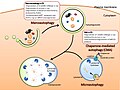 Autophagy


Ad. Transform your life with W8MD's
GLP-1 weight loss injections special from $29.99 with insurance
|
WikiMD Medical Encyclopedia |
Medical Disclaimer: WikiMD is for informational purposes only and is not a substitute for professional medical advice. Content may be inaccurate or outdated and should not be used for diagnosis or treatment. Always consult your healthcare provider for medical decisions. Verify information with trusted sources such as CDC.gov and NIH.gov. By using this site, you agree that WikiMD is not liable for any outcomes related to its content. See full disclaimer.
Credits:Most images are courtesy of Wikimedia commons, and templates, categories Wikipedia, licensed under CC BY SA or similar.
Translate this page: - East Asian
中文,
日本,
한국어,
South Asian
हिन्दी,
தமிழ்,
తెలుగు,
Urdu,
ಕನ್ನಡ,
Southeast Asian
Indonesian,
Vietnamese,
Thai,
မြန်မာဘာသာ,
বাংলা
European
español,
Deutsch,
français,
Greek,
português do Brasil,
polski,
română,
русский,
Nederlands,
norsk,
svenska,
suomi,
Italian
Middle Eastern & African
عربى,
Turkish,
Persian,
Hebrew,
Afrikaans,
isiZulu,
Kiswahili,
Other
Bulgarian,
Hungarian,
Czech,
Swedish,
മലയാളം,
मराठी,
ਪੰਜਾਬੀ,
ગુજરાતી,
Portuguese,
Ukrainian
