Trovafloxacin
A broad-spectrum antibiotic
| Trovafloxacin | |
|---|---|

| |
| INN | |
| Drug class | |
| Routes of administration | |
| Pregnancy category | |
| Bioavailability | |
| Metabolism | |
| Elimination half-life | |
| Excretion | |
| Legal status | |
| CAS Number | |
| PubChem | |
| DrugBank | |
| ChemSpider | |
| KEGG | |
Trovafloxacin is a broad-spectrum antibiotic that belongs to the class of drugs known as fluoroquinolones. It was developed to treat a variety of bacterial infections, including those of the respiratory tract, urinary tract, and skin.
Mechanism of Action[edit]
Trovafloxacin works by inhibiting bacterial DNA gyrase and topoisomerase IV, enzymes that are essential for bacterial DNA replication, transcription, repair, and recombination. This inhibition leads to the death of the bacteria, making trovafloxacin effective against a wide range of Gram-positive and Gram-negative bacteria.
Clinical Use[edit]
Trovafloxacin was initially approved for the treatment of serious infections such as pneumonia, intra-abdominal infections, and pelvic inflammatory disease. It was also used for nosocomial infections and community-acquired infections.
Safety Concerns[edit]
Despite its effectiveness, trovafloxacin was associated with serious hepatotoxicity, leading to severe liver damage in some patients. Due to these safety concerns, its use was significantly restricted by the U.S. Food and Drug Administration (FDA) in 1999. It is now only recommended for use in life-threatening infections where other antibiotics are not suitable.
Synthesis[edit]
The synthesis of trovafloxacin involves several chemical steps, starting from basic organic compounds. The process includes the formation of the quinolone core, followed by the addition of various functional groups that enhance its antibacterial activity.
Related pages[edit]
Trovafloxacin[edit]
-
 Chemical structure of Trovafloxacin
 -
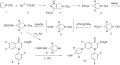 Synthesis pathway of Trovafloxacin

Ad. Transform your life with W8MD's
GLP-1 weight loss injections special from $29.99 with insurance
|
WikiMD Medical Encyclopedia |
Medical Disclaimer: WikiMD is for informational purposes only and is not a substitute for professional medical advice. Content may be inaccurate or outdated and should not be used for diagnosis or treatment. Always consult your healthcare provider for medical decisions. Verify information with trusted sources such as CDC.gov and NIH.gov. By using this site, you agree that WikiMD is not liable for any outcomes related to its content. See full disclaimer.
Credits:Most images are courtesy of Wikimedia commons, and templates, categories Wikipedia, licensed under CC BY SA or similar.
Translate this page: - East Asian
中文,
日本,
한국어,
South Asian
हिन्दी,
தமிழ்,
తెలుగు,
Urdu,
ಕನ್ನಡ,
Southeast Asian
Indonesian,
Vietnamese,
Thai,
မြန်မာဘာသာ,
বাংলা
European
español,
Deutsch,
français,
Greek,
português do Brasil,
polski,
română,
русский,
Nederlands,
norsk,
svenska,
suomi,
Italian
Middle Eastern & African
عربى,
Turkish,
Persian,
Hebrew,
Afrikaans,
isiZulu,
Kiswahili,
Other
Bulgarian,
Hungarian,
Czech,
Swedish,
മലയാളം,
मराठी,
ਪੰਜਾਬੀ,
ગુજરાતી,
Portuguese,
Ukrainian
