Garcinia pedunculata
Garcinia mangostana, commonly known as the mangosteen, is a tropical evergreen tree believed to have originated in the Sunda Islands and the Moluccas of Indonesia. It grows mainly in Southeast Asia, southwest India and other tropical areas such as Puerto Rico and Florida, where the tree has been introduced. The tree grows from 7 to 25 m (20–80 ft) tall. The fruit of the mangosteen is sweet and tangy, juicy, and somewhat fibrous, with an inedible, deep reddish-purple colored rind (exocarp) when ripe.
Description
The Garcinia mangostana tree is very slow-growing, erect, with a pyramidal crown. It has dark-brown or nearly black, flaking bark, the inner bark producing a yellow, gummy and bitter latex. The leaves are evergreen, opposite, short-stalked, oval or elliptic and leathery. The flowers are dark red or sometimes yellowish, with 4 sepals and 4 petals.
Cultivation
The Garcinia mangostana tree requires tropical conditions and annual rainfall of at least 50 inches to grow. It is propagated by seeds and by air-layering, but is not adapted to grafting. The tree begins to bear fruit at 7-10 years old.
Uses
The fruit of the Garcinia mangostana is eaten fresh. It is also canned and used in jellies. The rind of the fruit has been used in traditional medicine as a treatment for diarrhea, skin infections and wounds.
Health Benefits
The fruit is rich in antioxidants and may have anti-inflammatory properties. Some studies suggest that it may also have potential benefits in treating a variety of health conditions, including cancer, heart disease, and diabetes.
See Also

This medicinal plants related article is a stub. You can help WikiMD by expanding it.
-
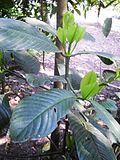 Garcinia pedunculata
 -
 Sukan thekera


Ad. Transform your life with W8MD's
GLP-1 weight loss injections special from $29.99 with insurance
|
WikiMD Medical Encyclopedia |
Medical Disclaimer: WikiMD is for informational purposes only and is not a substitute for professional medical advice. Content may be inaccurate or outdated and should not be used for diagnosis or treatment. Always consult your healthcare provider for medical decisions. Verify information with trusted sources such as CDC.gov and NIH.gov. By using this site, you agree that WikiMD is not liable for any outcomes related to its content. See full disclaimer.
Credits:Most images are courtesy of Wikimedia commons, and templates, categories Wikipedia, licensed under CC BY SA or similar.
Translate this page: - East Asian
中文,
日本,
한국어,
South Asian
हिन्दी,
தமிழ்,
తెలుగు,
Urdu,
ಕನ್ನಡ,
Southeast Asian
Indonesian,
Vietnamese,
Thai,
မြန်မာဘာသာ,
বাংলা
European
español,
Deutsch,
français,
Greek,
português do Brasil,
polski,
română,
русский,
Nederlands,
norsk,
svenska,
suomi,
Italian
Middle Eastern & African
عربى,
Turkish,
Persian,
Hebrew,
Afrikaans,
isiZulu,
Kiswahili,
Other
Bulgarian,
Hungarian,
Czech,
Swedish,
മലയാളം,
मराठी,
ਪੰਜਾਬੀ,
ગુજરાતી,
Portuguese,
Ukrainian
