Arctic
.svg)
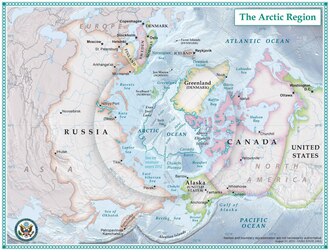


Arctic
The Arctic is a polar region located at the northernmost part of Earth. It consists of the Arctic Ocean, adjacent seas, and parts of Alaska (United States), Canada, Finland, Greenland (Denmark), Iceland, Norway, Russia, and Sweden. Land within the Arctic region has seasonally varying snow and ice cover, with predominantly cold and freezing temperatures. The Arctic's ice and snow are critical in cooling the Earth, reflecting sunlight back into space. However, global warming has led to significant ice melt, threatening the region's wildlife and indigenous cultures.
Geography[edit]
The Arctic is defined by the Arctic Circle, which is an imaginary line located at approximately 66° 33′ North latitude. The area within the Arctic Circle is characterized by unique geographical features, including the Arctic Ocean, tundra, and permafrost. The Arctic Ocean is surrounded by land and is mostly covered by sea ice, which varies seasonally in extent and thickness.
Climate[edit]
The climate in the Arctic is characterized by long, cold winters and short, cool summers. Temperatures can drop below −50 °C (−58 °F) in the winter and rise above 0 °C (32 °F) in the summer. Precipitation is low, mostly falling as snow. Climate change has led to a significant increase in temperatures in the Arctic, resulting in melting sea ice, glaciers, and permafrost.
Flora and Fauna[edit]
Despite the harsh conditions, the Arctic is home to diverse wildlife, including polar bears, seals, walruses, Arctic foxes, and numerous species of birds. The Arctic also supports unique plant life adapted to its cold environment. However, the changing climate poses a threat to the region's biodiversity.
Indigenous Peoples[edit]
The Arctic is inhabited by various indigenous peoples, including the Inuit, Saami, and Nenets, who have adapted to its challenging conditions over thousands of years. These communities rely on the Arctic's natural resources for their traditional lifestyles, including hunting, fishing, and reindeer herding.
Economic Activities[edit]
Economic activities in the Arctic include fishing, hunting, mining, and oil and gas extraction. However, these activities are often controversial due to their environmental impact and the threat they pose to the traditional lifestyles of indigenous peoples.
Environmental Concerns[edit]
The Arctic is particularly vulnerable to the effects of climate change, including rising temperatures, melting ice, and changing ecosystems. These changes have global implications, including rising sea levels and altered weather patterns. Conservation efforts are critical to preserving the Arctic's unique environment and supporting its indigenous communities.
Exploration and Research[edit]
The Arctic has a long history of exploration, from early voyages by indigenous peoples to modern scientific research. Today, the Arctic is a focus for studies on climate change and its global effects, with international cooperation essential for understanding and addressing these challenges.

Ad. Transform your health with W8MD Weight Loss, Sleep & MedSpa

Tired of being overweight?
Special offer:
Budget GLP-1 weight loss medications
- Semaglutide starting from $29.99/week and up with insurance for visit of $59.99 and up per week self pay.
- Tirzepatide starting from $45.00/week and up (dose dependent) or $69.99/week and up self pay
✔ Same-week appointments, evenings & weekends
Learn more:
- GLP-1 weight loss clinic NYC
- W8MD's NYC medical weight loss
- W8MD Philadelphia GLP-1 shots
- Philadelphia GLP-1 injections
- Affordable GLP-1 shots NYC
|
WikiMD Medical Encyclopedia |
Medical Disclaimer: WikiMD is for informational purposes only and is not a substitute for professional medical advice. Content may be inaccurate or outdated and should not be used for diagnosis or treatment. Always consult your healthcare provider for medical decisions. Verify information with trusted sources such as CDC.gov and NIH.gov. By using this site, you agree that WikiMD is not liable for any outcomes related to its content. See full disclaimer.
Credits:Most images are courtesy of Wikimedia commons, and templates, categories Wikipedia, licensed under CC BY SA or similar.
Translate this page: - East Asian
中文,
日本,
한국어,
South Asian
हिन्दी,
தமிழ்,
తెలుగు,
Urdu,
ಕನ್ನಡ,
Southeast Asian
Indonesian,
Vietnamese,
Thai,
မြန်မာဘာသာ,
বাংলা
European
español,
Deutsch,
français,
Greek,
português do Brasil,
polski,
română,
русский,
Nederlands,
norsk,
svenska,
suomi,
Italian
Middle Eastern & African
عربى,
Turkish,
Persian,
Hebrew,
Afrikaans,
isiZulu,
Kiswahili,
Other
Bulgarian,
Hungarian,
Czech,
Swedish,
മലയാളം,
मराठी,
ਪੰਜਾਬੀ,
ગુજરાતી,
Portuguese,
Ukrainian
