Corn chowder
Corn Chowder is a type of soup or chowder which uses corn as its primary ingredient. Originating from North America, it is a traditional dish with many variations and is popular in regions where corn is a staple food.
History
The history of Corn Chowder can be traced back to the Native Americans, who were the first to cultivate corn, also known as maize. The dish was later adopted by European settlers in North America, who added their own ingredients and variations.
Ingredients
The basic ingredients of Corn Chowder include corn, onion, celery, milk or cream, and butter. Some variations may also include potato, bacon, chicken, or seafood. The dish is typically thickened with a roux, which is a mixture of fat and flour.
Preparation
To prepare Corn Chowder, the corn kernels are first removed from the cob and then cooked with the other ingredients. The soup is typically simmered until the ingredients are tender and the flavors are well combined. Some recipes may call for the soup to be pureed for a smoother texture, while others may leave it chunky.
Variations
There are many variations of Corn Chowder, depending on the region and personal preference. Some versions may include additional vegetables, such as carrots or bell peppers, while others may include different types of meat or seafood. In the Southern United States, for example, a popular variation includes crab or shrimp.
Nutritional Value
Corn Chowder is high in vitamin A, vitamin C, and fiber, thanks to the corn and other vegetables. However, it can also be high in fat and calories, depending on the amount of butter, cream, and meat used.
See Also

-
 Vegan Garden Corn Chowder with Chives
 -
 Potato and Corn Chowder
 -
 Safeway Signature Cafe Corn Chowder
 -
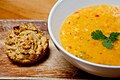 Vegan Corn Chowder with Cornbread
 -
 Cups of Corn Chowder with Bacon, Potato, Olive Oil and Chives
 -
 Mexican Chicken Corn Chowder
 -
 Shrimp and Corn Chowder
 -
 Corn Chowder with Crab
 -
 Scallops Corn Chowder
 -
 Corn Chowder Close-up
.jpg)


Medical Disclaimer: WikiMD is for informational purposes only and is not a substitute for professional medical advice. Content may be inaccurate or outdated and should not be used for diagnosis or treatment. Always consult your healthcare provider for medical decisions. Verify information with trusted sources such as CDC.gov and NIH.gov. By using this site, you agree that WikiMD is not liable for any outcomes related to its content. See full disclaimer.
Credits:Most images are courtesy of Wikimedia commons, and templates, categories Wikipedia, licensed under CC BY SA or similar.
Translate this page: - East Asian
中文,
日本,
한국어,
South Asian
हिन्दी,
தமிழ்,
తెలుగు,
Urdu,
ಕನ್ನಡ,
Southeast Asian
Indonesian,
Vietnamese,
Thai,
မြန်မာဘာသာ,
বাংলা
European
español,
Deutsch,
français,
Greek,
português do Brasil,
polski,
română,
русский,
Nederlands,
norsk,
svenska,
suomi,
Italian
Middle Eastern & African
عربى,
Turkish,
Persian,
Hebrew,
Afrikaans,
isiZulu,
Kiswahili,
Other
Bulgarian,
Hungarian,
Czech,
Swedish,
മലയാളം,
मराठी,
ਪੰਜਾਬੀ,
ગુજરાતી,
Portuguese,
Ukrainian
