Arthur Sewall
A sustainable food production system combining aquaculture and hydroponics
Aquaponics is an integrated system of aquaculture and hydroponics that cultivates fish and plants together in a symbiotic environment. This sustainable method of food production leverages the natural biological cycles of fish and plants to create a closed-loop system that minimizes waste and maximizes resource efficiency.
Overview
Aquaponics combines the principles of aquaculture, the raising of aquatic animals such as fish, and hydroponics, the cultivation of plants in water without soil. In an aquaponic system, fish waste provides an organic nutrient source for the plants, and the plants help to purify the water for the fish. This creates a mutually beneficial environment where both fish and plants can thrive.
System Components
An aquaponic system typically consists of several key components:
- Fish Tank: The primary habitat for the fish, where they are fed and grow. Fish waste accumulates in the water, which is then circulated to the plant beds.
- Biofilter: A crucial component where nitrifying bacteria convert ammonia from fish waste into nitrates, which are less toxic and can be absorbed by plants.
- Plant Beds: These are usually filled with a growing medium such as gravel or clay pellets, where plants are cultivated. The plants absorb the nitrates and other nutrients, cleaning the water in the process.
- Sump Tank: A reservoir that collects water from the plant beds and pumps it back to the fish tank, completing the cycle.
Benefits
Aquaponics offers several advantages over traditional farming and aquaculture:
- Water Efficiency: Aquaponics uses significantly less water than soil-based agriculture because the water is recirculated and reused.
- Sustainability: By integrating fish and plant production, aquaponics reduces the need for chemical fertilizers and minimizes waste.
- Space Efficiency: Aquaponic systems can be set up in urban environments, making them ideal for city farming and reducing the need for large tracts of land.
- Year-Round Production: With controlled environments, aquaponics can produce food year-round, regardless of external weather conditions.
Challenges
Despite its benefits, aquaponics also presents several challenges:
- Initial Setup Costs: The cost of setting up an aquaponic system can be high, requiring investment in tanks, pumps, and other equipment.
- Technical Knowledge: Successful aquaponics requires understanding of both aquaculture and hydroponics, as well as the biological processes involved.
- System Maintenance: Regular monitoring and maintenance are necessary to ensure the health of both fish and plants.
Applications
Aquaponics is used in various settings, from small-scale home systems to large commercial operations. It is particularly valuable in areas with limited water resources or poor soil quality. Educational institutions also use aquaponics as a teaching tool to demonstrate principles of biology, ecology, and sustainability.
Gallery
-
 Portable fish farm at Growing Power
 -
 UVI aquaponic system
 -
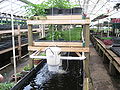 Aquaponics at Growing Power, Milwaukee
 -
 CDC South aquaponics raft tank
 -
 Aquaponics with vibrantly colored plants
 -
 Spinach sapling in aquaponics
 -
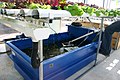 Aquaponics with catfish


Related pages
Ad. Transform your life with W8MD's
GLP-1 weight loss injections special from $29.99 with insurance
|
WikiMD Medical Encyclopedia |
Medical Disclaimer: WikiMD is for informational purposes only and is not a substitute for professional medical advice. Content may be inaccurate or outdated and should not be used for diagnosis or treatment. Always consult your healthcare provider for medical decisions. Verify information with trusted sources such as CDC.gov and NIH.gov. By using this site, you agree that WikiMD is not liable for any outcomes related to its content. See full disclaimer.
Credits:Most images are courtesy of Wikimedia commons, and templates, categories Wikipedia, licensed under CC BY SA or similar.
Translate this page: - East Asian
中文,
日本,
한국어,
South Asian
हिन्दी,
தமிழ்,
తెలుగు,
Urdu,
ಕನ್ನಡ,
Southeast Asian
Indonesian,
Vietnamese,
Thai,
မြန်မာဘာသာ,
বাংলা
European
español,
Deutsch,
français,
Greek,
português do Brasil,
polski,
română,
русский,
Nederlands,
norsk,
svenska,
suomi,
Italian
Middle Eastern & African
عربى,
Turkish,
Persian,
Hebrew,
Afrikaans,
isiZulu,
Kiswahili,
Other
Bulgarian,
Hungarian,
Czech,
Swedish,
മലയാളം,
मराठी,
ਪੰਜਾਬੀ,
ગુજરાતી,
Portuguese,
Ukrainian
