Underwater diving
Underwater diving is the practice of descending below the water's surface to conduct various activities, such as exploration, research, or recreation. It encompasses a range of techniques and equipment, from simple breath-hold diving to complex saturation diving operations.
History
The history of underwater diving dates back to ancient times, with early divers using reeds to breathe underwater. The development of diving bells in the 16th century marked a significant advancement. In the 20th century, the invention of the aqualung by Jacques Cousteau and [[�mile Gagnan]] revolutionized diving, allowing divers to explore the underwater world with greater freedom.
Types of Diving
Recreational Diving
Recreational diving is primarily for enjoyment and includes activities such as scuba diving, snorkeling, and freediving. It is often conducted in warm, clear waters and involves exploring coral reefs, shipwrecks, and marine life.
Technical Diving
Technical diving involves more advanced techniques and equipment, allowing divers to go deeper and stay underwater longer. It includes cave diving, wreck diving, and deep diving. Technical divers often use mixed gases like trimix or heliox to manage the risks associated with deep dives.
Commercial Diving
Commercial diving is performed for industrial purposes, such as underwater construction, inspection, and maintenance. It often involves the use of specialized equipment like diving bells and saturation systems.
Military Diving
Military diving includes operations conducted by naval forces, such as explosive ordnance disposal and underwater demolition. Military divers are trained to perform in various environments and conditions.
Equipment
Breathing Apparatus
Divers use different types of breathing apparatus depending on the type of diving. Scuba (self-contained underwater breathing apparatus) is the most common for recreational diving, while surface-supplied systems are used in commercial diving.
Diving Suits
Diving suits protect divers from cold water and hazardous environments. Wetsuits and drysuits are commonly used, with drysuits providing better insulation in cold conditions.
Other Equipment
Additional equipment includes fins, masks, buoyancy compensators, and dive computers. These tools help divers navigate, communicate, and monitor their dive profiles.
Safety
Safety is a critical aspect of diving. Divers must be aware of potential hazards such as decompression sickness, nitrogen narcosis, and barotrauma. Proper training, equipment maintenance, and adherence to dive plans are essential for safe diving practices.
Related Pages
Gallery
-
 A diving stage used in commercial diving.
 -
 Example of mask squeeze, a common diving injury.
 -
 A diver wearing a flat mask.
 -
 Divers preparing for a dive.
 -
 Divers using DIR (Doing It Right) equipment configuration.
 -
 US Navy EOD divers.
 -
 A US Navy diver entering the water.
 -
 A diver transfer capsule used in saturation diving.
 -
 A Navy diver in action.
 -
 The submersible "Limiting Factor" being prepared for a dive.
 -
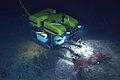 NOAA diver conducting research.
 -
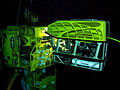 An ROV working on a subsea structure.
 -
 A working diver performing underwater tasks.
 -
 A US Navy diver during a training exercise.
 -
 Historical depiction of Alexander the Great diving.
 -
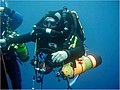 A diver returning from a shipwreck dive.
 -
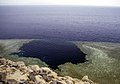 The Blue Hole, a popular dive site.
 -
 Commercial diver training at a quarry.
 -
 A decompression chamber used for treating decompression sickness.
 -
 The Alfa flag, indicating a diver below.
 -
 The diver down flag.
 -
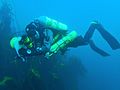 A diver preparing for a dive.
 -
 Another working diver performing tasks underwater.


.jpg)

_divers.jpg)


-
Underwater_diving
-
Underwater_diving
-
Underwater_diving
-
Underwater_diving
-
Underwater_diving
-
Underwater_diving
-
Underwater_diving
-
Underwater_diving
-
Underwater_diving
-
Underwater_diving
-
Underwater_diving
-
Underwater_diving
Ad. Transform your life with W8MD's
GLP-1 weight loss injections special from $29.99 with insurance
|
WikiMD Medical Encyclopedia |
Medical Disclaimer: WikiMD is for informational purposes only and is not a substitute for professional medical advice. Content may be inaccurate or outdated and should not be used for diagnosis or treatment. Always consult your healthcare provider for medical decisions. Verify information with trusted sources such as CDC.gov and NIH.gov. By using this site, you agree that WikiMD is not liable for any outcomes related to its content. See full disclaimer.
Credits:Most images are courtesy of Wikimedia commons, and templates, categories Wikipedia, licensed under CC BY SA or similar.
Translate this page: - East Asian
中文,
日本,
한국어,
South Asian
हिन्दी,
தமிழ்,
తెలుగు,
Urdu,
ಕನ್ನಡ,
Southeast Asian
Indonesian,
Vietnamese,
Thai,
မြန်မာဘာသာ,
বাংলা
European
español,
Deutsch,
français,
Greek,
português do Brasil,
polski,
română,
русский,
Nederlands,
norsk,
svenska,
suomi,
Italian
Middle Eastern & African
عربى,
Turkish,
Persian,
Hebrew,
Afrikaans,
isiZulu,
Kiswahili,
Other
Bulgarian,
Hungarian,
Czech,
Swedish,
മലയാളം,
मराठी,
ਪੰਜਾਬੀ,
ગુજરાતી,
Portuguese,
Ukrainian
