Mecoprop: Difference between revisions
CSV import Tags: mobile edit mobile web edit |
CSV import |
||
| Line 24: | Line 24: | ||
{{Chemical-compound-stub}} | {{Chemical-compound-stub}} | ||
{{medicine-stub}} | {{medicine-stub}} | ||
== Mecoprop gallery == | |||
<gallery> | |||
File:Mecoprop.svg|Mecoprop structure | |||
File:Mecoprop-racemic-dimer-from-xtal-labelled-3D-balls.png|Mecoprop racemic dimer 3D balls | |||
File:(±)-Mecoprop Enantiomers Formulae.png|(±)-Mecoprop Enantiomers Formulae | |||
</gallery> | |||
Latest revision as of 05:10, 3 March 2025
Mecoprop (or MCPP) is a chemical compound used as a selective herbicide. It is a member of the phenoxy herbicide group and is commonly used for the post-emergence control of annual and perennial broadleaf weeds in a variety of crops and environments.
Chemical Structure and Properties[edit]
Mecoprop is a chiral compound, meaning it has two enantiomers, or forms that are mirror images of each other. These enantiomers have different biological activities, with the (R)-enantiomer being more active as a herbicide than the (S)-enantiomer. Mecoprop is often sold as a mixture of both enantiomers.
The chemical formula of mecoprop is C10H11ClO3, and it has a molecular weight of 214.64 g/mol. It is a white crystalline solid at room temperature, with a melting point of 114-116 °C and a boiling point of 210-220 °C.
Uses[edit]
Mecoprop is used to control a wide range of broadleaf weeds, including dandelion, clover, and ground ivy. It is used in both agricultural and non-agricultural settings, including lawns, golf courses, and other turf areas.
Health Effects[edit]
Exposure to mecoprop can cause a variety of health effects, depending on the route and duration of exposure. Short-term exposure can cause skin and eye irritation, while long-term exposure can cause damage to the liver and kidneys. Mecoprop is also a potential endocrine disruptor.
Environmental Impact[edit]
Mecoprop is moderately persistent in the environment, with a half-life in soil of 1-3 weeks. It is highly soluble in water and can leach into groundwater. It is also toxic to some aquatic organisms.
Regulation[edit]
In the European Union, mecoprop is approved for use as a herbicide under certain conditions. In the United States, it is classified as a general use pesticide by the Environmental Protection Agency.
This article is a Chemical compound-related stub. You can help WikiMD by expanding it!

Mecoprop gallery[edit]
-
 Mecoprop structure
 -
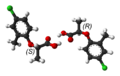 Mecoprop racemic dimer 3D balls
 -
 (±)-Mecoprop Enantiomers Formulae


-Mecoprop_Enantiomers_Formulae.png)
