Curry tree: Difference between revisions
CSV import |
CSV import |
||
| Line 24: | Line 24: | ||
[[Category:Sri Lankan cuisine]] | [[Category:Sri Lankan cuisine]] | ||
{{food-stub}} | {{food-stub}} | ||
== Curry_tree == | |||
<gallery> | |||
File:Curry_Trees.jpg|Curry Trees | |||
File:Curry_Tree_flower.JPG|Curry Tree Flower | |||
File:Fresh_curry_Leaf_(49697684423).jpg|Fresh Curry Leaf | |||
File:CurryLeaf_Fruits.jpg|Curry Leaf Fruits | |||
File:Girinimbine.png|Girinimbine | |||
</gallery> | |||
Latest revision as of 00:53, 27 February 2025
Curry Tree (Murraya koenigii) is a tropical to sub-tropical tree in the family Rutaceae, which is native to India and Sri Lanka. Its leaves are widely used in southern and west-coast Indian cooking and Sri Lankan cooking, especially in curries.
Description[edit]
The Curry Tree is a small tree, growing 4–6 m tall, with a trunk up to 40 cm diameter. The leaves are pinnate, with 11–21 leaflets, each leaflet 2–4 cm long and 1–2 cm broad. The plant produces small white flowers which can self-pollinate to produce small shiny-black drupes containing a single, large viable seed.
Cultivation and uses[edit]
The leaves of the Curry Tree are highly aromatic and are used as a herb in Indian and Sri Lankan cuisines. They are most widely used in southern and west coast Indian cooking, usually fried along with vegetable oil, mustard seeds and chopped onions in the first stage of the preparation. They are also used to make Thoran, vada, Rasam and Kadhi.
In their fresh form, they have a short shelf life and do not keep well in the refrigerator. They are also available dried, though the aroma is largely inferior.
Medicinal uses[edit]
The Curry Tree is also of interest for its medicinal properties. It has been used in Ayurvedic medicine for treating diabetes, and some Indian tribes use it for its anthelmintic properties.
See also[edit]

Curry_tree[edit]
-
 Curry Trees
 -
 Curry Tree Flower
 -
 Fresh Curry Leaf
 -
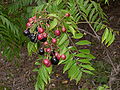 Curry Leaf Fruits
 -
Girinimbine


.jpg)


