Fatányéros: Difference between revisions
CSV import |
CSV import |
||
| Line 26: | Line 26: | ||
File:Fatányéros_2.jpg | File:Fatányéros_2.jpg | ||
File:Plankstek.jpg | File:Plankstek.jpg | ||
</gallery> | |||
<gallery> | |||
File:Fatányéros_2.jpg|Fatányéros 2 | |||
File:Plankstek.jpg|Plankstek | |||
</gallery> | </gallery> | ||
Latest revision as of 11:44, 25 February 2025
Fatányéros is a traditional Hungarian dish, typically served as a mixed grill on a wooden platter. The name 'Fatányéros' is derived from the Hungarian words 'fatányér', meaning wooden platter, and 'ros', meaning roast.
History[edit]
The dish has its roots in the Hungarian countryside, where it was traditionally prepared over an open fire. The exact origins of Fatányéros are unclear, but it is believed to have been a popular dish among Hungarian shepherds and farmers in the 19th century.
Preparation[edit]
Fatányéros is typically made with a variety of meats, including pork, beef, chicken, and lamb. The meats are marinated in a mixture of paprika, garlic, onion, and pepper, then skewered and grilled. The grilled meats are then served on a wooden platter, often accompanied by potato wedges, pickles, and a variety of sauces.
Variations[edit]
There are many regional variations of Fatányéros throughout Hungary. In some regions, the dish is served with sausages and bacon, while in others, it is served with vegetables such as bell peppers and tomatoes. Some versions of the dish also include fish or game meat.
Cultural Significance[edit]
Fatányéros is often served at traditional Hungarian festivals and celebrations, and is considered a symbol of Hungarian hospitality. It is also a popular dish in Hungarian restaurants, both in Hungary and abroad.
See Also[edit]
| Hungarian cuisine | ||||||||||
|---|---|---|---|---|---|---|---|---|---|---|
This Hungarian cuisine-related article is a stub.
|


-
 Fatányéros 2
 -
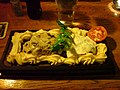 Plankstek
