Population: Difference between revisions
CSV import Tags: mobile edit mobile web edit |
CSV import Tags: mobile edit mobile web edit |
||
| Line 44: | Line 44: | ||
{{Demography-stub}} | {{Demography-stub}} | ||
== Population == | |||
<gallery> | |||
File:Population_density_key.png|Population density key | |||
File:World_population_growth_-_time_between_each_billion-person_growth.svg|World population growth - time between each billion-person growth | |||
File:Poulation-since-10000BC.jpg|Population since 10000 BC | |||
File:Poulation-since-1000AD.jpg|Population since 1000 AD | |||
File:PRB_2017_Data_Sheet_Largest_Populations.jpg|PRB 2017 Data Sheet Largest Populations | |||
</gallery> | |||
Latest revision as of 21:43, 23 February 2025
Population refers to the total number of individuals or inhabitants in a particular area or region at a specific time. The study of populations is covered under the field of demography, which analyzes the structure, dynamics, and growth of populations. This includes the examination of birth rates, death rates, age distribution, and migration patterns.
Definition and Measurement[edit]
The population of a region can be defined as the number of people living in that region. It is measured through a census, which is an official count or survey of a population, typically recording various details of individuals. Population can also be estimated through sampling methods between censuses.
Components of Population Change[edit]
Population change can occur due to three main factors:
- Birth rate - the number of live births per 1,000 people per year.
- Death rate - the number of deaths per 1,000 people per year.
- Migration - the movement of people into (immigration) or out of (emigration) a geographic area.
Population Growth[edit]
Population growth refers to the increase in the number of individuals in a population. Global population growth is influenced by many factors, including economic development, education, access to health care, and social norms. Overpopulation can lead to environmental degradation, resource depletion, and challenges in providing adequate services.
Demographic Transition[edit]
The demographic transition model describes the transformation of a country from high birth and death rates to low birth and death rates as a result of economic and social development. This model is typically divided into four stages:
- High birth and death rates
- Declining death rates
- Declining birth rates
- Low birth and death rates
Population Policies[edit]
Governments may implement population policies to control or influence the population growth and structure. These policies can include promoting family planning, creating incentives for smaller families, or implementing policies aimed at boosting the birth rate.
Challenges and Issues[edit]
Rapid population growth and high population density can pose several challenges, including:
- Strain on infrastructure and public services
- Environmental degradation
- Increased competition for jobs and resources
- Social and political unrest
Conversely, countries with declining populations face challenges such as a shrinking workforce, increased burden of healthcare for the elderly, and potential economic decline.
See Also[edit]
 | This social science-related article is a stub. You can help Wikipedia by adding missing information. |
Population[edit]
-
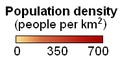 Population density key
 -
 World population growth - time between each billion-person growth
 -
 Population since 10000 BC
 -
 Population since 1000 AD
 -
 PRB 2017 Data Sheet Largest Populations


