Meyer lemon: Difference between revisions
CSV import |
CSV import |
||
| Line 24: | Line 24: | ||
[[Category:Hybrid citrus]] | [[Category:Hybrid citrus]] | ||
{{citrus-stub}} | {{citrus-stub}} | ||
== Meyer_lemon == | |||
<gallery> | |||
File:Meyer_Lemon.jpg|Meyer Lemon | |||
File:MeyerLemon.jpg|Meyer Lemon | |||
File:Meyer_Lemon_hanging.jpg|Meyer Lemon hanging | |||
File:Improved_Meyer_Lemon_Early_Flower.jpg|Improved Meyer Lemon Early Flower | |||
</gallery> | |||
Latest revision as of 21:41, 23 February 2025
Meyer Lemon
The Meyer lemon (Citrus × meyeri), is a hybrid citrus fruit native to China. It is a cross between a citron and a mandarin/pomelo hybrid distinct from the common or bitter oranges.
Description[edit]
Meyer lemons are rounder than a true lemon. The skin is fragrant and thin, colored a deep yellow with a slight orange tint when ripe. Meyer lemon fruits have a sweeter, less acidic flavor than the more common Lisbon or Eureka lemon varieties. The pulp is a dark yellow and contains up to 10 seeds per fruit.
Cultivation[edit]
Meyer lemons are popular as an ornamental plant for their compact size, hardiness, and prolific fruiting. They are more resistant to cold than other lemon varieties. Meyer lemons are also grown for their distinctive flavor in gourmet cooking and are available year-round.
History[edit]
The Meyer lemon was first introduced to the United States in 1908 as S.P.I. #23028 by the agricultural explorer Frank Nicholas Meyer, an employee of the United States Department of Agriculture who collected a sample of the plant on a trip to China.
Uses[edit]
Meyer lemons are used in a wide variety of food and drink. The peel can be used to add flavor to baked goods, marinades, and cocktails. The juice and pulp are used in pies, cookies, and other desserts due to their unique flavor.
See also[edit]

Meyer_lemon[edit]
-
 Meyer Lemon
 -
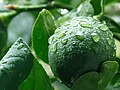 Meyer Lemon
 -
 Meyer Lemon hanging
 -
 Improved Meyer Lemon Early Flower


