Rectus sheath hematoma: Difference between revisions
CSV import |
CSV import |
||
| Line 25: | Line 25: | ||
[[Category:Surgery]] | [[Category:Surgery]] | ||
{{Medicine-stub}} | {{Medicine-stub}} | ||
<gallery> | |||
File:Rectus abdominis.png|Rectus abdominis muscle | |||
File:CT of rectus sheath hematomas.png|CT of rectus sheath hematomas | |||
File:Rektusscheidenhaematom - CT axial - mit aktiver Blutung.jpg|CT axial view with active bleeding | |||
File:UOTW 13 - Ultrasound of the Week 1.webm|Ultrasound of rectus sheath hematoma | |||
</gallery> | |||
Revision as of 01:30, 20 February 2025
Rectus Sheath Hematoma (RSH) is a rare, often misdiagnosed condition that involves the accumulation of blood within the Rectus sheath, the fibrous layer of connective tissue that encloses the Rectus abdominis muscle. This condition is typically caused by damage to the Superior epigastric artery or Inferior epigastric artery, which supply blood to the rectus abdominis muscle.
Etiology
The most common causes of Rectus Sheath Hematoma are trauma, anticoagulation therapy, and strenuous physical activity. Other factors that may contribute to the development of this condition include pregnancy, surgery, and certain medical procedures such as coughing, Valsalva maneuver, and Colonoscopy.
Clinical Presentation
Patients with Rectus Sheath Hematoma typically present with sudden onset of abdominal pain, often accompanied by a palpable abdominal mass. Other symptoms may include nausea, vomiting, and signs of Hemodynamic instability such as tachycardia and hypotension.
Diagnosis
Diagnosis of Rectus Sheath Hematoma can be challenging due to its nonspecific clinical presentation. It is often misdiagnosed as other conditions such as acute Appendicitis, Cholecystitis, or Diverticulitis. Diagnostic tools that can aid in the identification of this condition include Ultrasound, CT scan, and MRI.
Treatment
Treatment of Rectus Sheath Hematoma is largely dependent on the severity of the condition. Conservative management, including bed rest, analgesia, and cessation of anticoagulation therapy, is often sufficient for small hematomas. Larger hematomas may require surgical intervention, such as Embolization or Laparotomy.
Prognosis
The prognosis for Rectus Sheath Hematoma is generally good, especially when the condition is diagnosed and treated promptly. However, complications can occur, particularly in patients with large hematomas or underlying medical conditions.

-
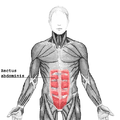 Rectus abdominis muscle
 -
 CT of rectus sheath hematomas
 -
 CT axial view with active bleeding
 -
 Ultrasound of rectus sheath hematoma


