Sauerkraut: Difference between revisions
CSV import |
CSV import |
||
| Line 33: | Line 33: | ||
[[Category:Cabbage dishes]] | [[Category:Cabbage dishes]] | ||
{{food-stub}} | {{food-stub}} | ||
<gallery> | |||
File:Kiszona kapusta.JPG|Sauerkraut | |||
File:Saurkraut (cropped).JPG|Sauerkraut | |||
File:Cavolo salato.jpg|Sauerkraut | |||
File:Sauerkraut 2.jpg|Sauerkraut | |||
File:Zuurkool in pan.jpg|Sauerkraut | |||
File:08023 dumplings stuffed with sauerkraut.JPG|Dumplings stuffed with sauerkraut | |||
File:Cabbage Soup Kapuśniak 01.JPG|Cabbage Soup Kapuśniak | |||
File:Czech sausages and sauerkraut at restaurant Poseidon, Helsinki (bright).jpg|Czech sausages and sauerkraut | |||
File:VeproKnedloZelo-00.jpg|Vepřo knedlo zelo | |||
File:Eisbein-2.jpg|Eisbein with sauerkraut | |||
File:Choucroute-p1030190.jpg|Choucroute | |||
</gallery> | |||
Latest revision as of 01:12, 20 February 2025
| File:Sauerkraut.jpg | |
| A serving of sauerkraut | |
| Alternative names | |
| Type | |
| Course | Side dish |
| Place of origin | Germany |
| Region or state | |
| Associated national cuisine | |
| Created by | |
| Invented | |
| Cooking time | minutes to minutes |
| Serving temperature | Cold or hot |
| Main ingredients | Cabbage, salt |
| Ingredients generally used | |
| Variations | |
| Food energy | kcal |
| Nutritional value | Protein: g, Fat: g, Carbohydrate: g |
| Glycemic index | |
| Similar dishes | |
| Other information | |
| Website | [ Official website] |
Sauerkraut is a type of fermented cabbage that is popular in many Central European and Eastern European cuisines. The name "sauerkraut" is a German word that literally translates to "sour cabbage". It is made by a process of pickling called lactic acid fermentation, in which natural bacteria feed on the sugar in the cabbage leaves, producing lactic acid. This process not only preserves the cabbage but also gives sauerkraut its distinctive sour flavor.
History[edit]
The origins of sauerkraut are believed to date back to ancient times, with the Chinese using fermented cabbage as food during the building of the Great Wall of China. The technique was later brought to Europe, where it became a staple in German, Polish, and Russian diets. It was particularly valued for its vitamin C content, providing a crucial nutrient during the winter months when fresh vegetables were scarce.
Preparation[edit]
To prepare sauerkraut, finely shredded cabbage is mixed with salt and tightly packed into a sealed container. The salt draws out water from the cabbage, creating a brine that prevents the growth of unwanted microorganisms. Over a period of several weeks, the cabbage ferments at room temperature. During this time, the lactic acid bacteria naturally present on the cabbage leaves proliferate, fermenting the cabbage's sugars into lactic acid.
Nutritional Value[edit]
Sauerkraut is low in calories but high in vitamin C, dietary fiber, and probiotics, which are beneficial for the gastrointestinal tract. It is also a source of vitamin K, vitamin B6, folate, iron, potassium, and manganese.
Culinary Uses[edit]
Sauerkraut can be served both hot and cold and is often used as a side dish or condiment. It is a traditional accompaniment to dishes such as pork, sausages, and potatoes. In some cuisines, it is also used as a filling for dumplings and pierogi.
Cultural Significance[edit]
In addition to its culinary uses, sauerkraut holds cultural significance in many countries. It is associated with traditional celebrations and holidays, particularly in Germany and Eastern Europe. Sauerkraut is also celebrated for its health benefits, including its ability to aid digestion and boost the immune system.
See Also[edit]

-
Sauerkraut
-
Sauerkraut
-
 Sauerkraut
 -
 Sauerkraut
 -
 Sauerkraut
 -
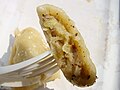 Dumplings stuffed with sauerkraut
 -
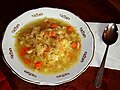 Cabbage Soup Kapuśniak
 -
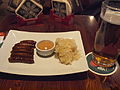 Czech sausages and sauerkraut
 -
 Vepřo knedlo zelo
 -
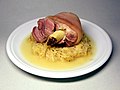 Eisbein with sauerkraut
 -
Choucroute


.jpg)


.JPG)
